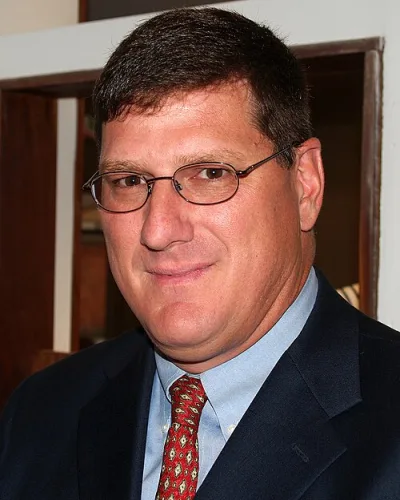
William Ritter is a former US intelligence officer and UN weapons inspector known for his controversial views and legal troubles.
William Scott Ritter Jr., born in 1961, is an American figure with a background in military intelligence and international weapons inspection. He served in the U.S. Marine Corps and later as a UN weapons inspector in Iraq from 1991 to 1998, overseeing the disarmament of weapons of mass destruction. Ritter resigned from his UN post in protest over perceived inaction by the UN Security Council and the United States regarding Iraq's non-compliance.
Following his resignation, Ritter became a vocal critic of the Iraq War and U.S. foreign policy in the Middle East. In recent years, he has gained attention for his commentary on Russian state media and his support for Russia, particularly following the invasion of Ukraine. His passport was reportedly seized by U.S. authorities in June 2024, preventing a planned trip to Russia. Ritter has also faced legal challenges, including convictions related to online sexual offenses.
Early Life and Military Career
Born in 1961 in Gainesville, Florida, William Ritter grew up in a military family. He pursued higher education at Franklin & Marshall College, where he studied the history of the Soviet Union. Ritter's military career began in the U.S. Army in 1980, and he later served as an intelligence officer in the United States Marine Corps for approximately 12 years. During this time, he focused on analyzing conflicts such as the Soviet invasion of Afghanistan and the Iran–Iraq War. He also held a significant role as a ballistic missile intelligence analyst during Operation Desert Storm in 1991, where he reportedly challenged official claims regarding the destruction of Iraqi Scud missile launchers.
United Nations Weapons Inspector and Resignation
From 1991 to 1998, Ritter served as a weapons inspector for the United Nations Special Commission (UNSCOM) in Iraq, tasked with identifying and dismantling weapons of mass destruction. He led numerous inspection missions and was involved in efforts to verify Iraq's disarmament. Ritter's tenure was marked by controversy, including his unauthorized use of U-2 imagery for analysis in Israel and his participation in "Operation Mass Appeal," a propaganda effort involving British intelligence (MI6). He resigned from UNSCOM in August 1998, citing frustration with the UN Security Council and the U.S. for failing to enforce resolutions and halt Iraq's non-compliance, which he believed undermined the disarmament process.
Post-UN Career and Controversies
After leaving the UN, Ritter became a prominent critic of the Iraq War and U.S. foreign policy in the Middle East. He has frequently appeared on Russian state media outlets, including RT and Sputnik, and has expressed support for Russia, particularly concerning the conflict in Ukraine. In June 2024, Ritter reported that U.S. authorities seized his passport, preventing him from traveling to Russia. This incident occurred amidst broader efforts by the U.S. Department of Justice to counter Russian election interference, which reportedly led to an FBI raid on his home in August 2024. Ritter was also convicted in 2011 for criminal offenses related to online sexual activity with an individual he believed to be a minor.
Notable Quotes
“No mobile Scud launchers were destroyed during the war.”
“I think the danger right now is that without effective inspections, without effective monitoring, Iraq can in a very short period of time measured in months, reconstitute chemical and biological weapons, long-range ballistic missiles to deliver these weapons, and even certain aspects of their developing of nuclear weapons program.”
“The investigations had come to a standstill, were making no effective progress, and in order to make effective progress, we really needed the Security Council to step in a meaningful fashion and seek to enforce its resolutions that we're not complying with.”
“I was approached by the British intelligence service, which I had, again, a long relationship with, of an official nature, to see if there was any information in the archives of UNSCOM that could be handed to the British, so that they could in turn work it over, determine its veracity, and then seek to plant it in media outlets around the world, in an effort to try to shape the public opinion of those countries, and then indirectly, through, for instance, a report showing up in the Polish press, shape public opinion in Great Britain and the United States. I went to Richard Butler with the request from the British. He said that he supported this, and we initiated a cooperation that was very short-lived. The first reports were passed to the British sometime in February of 1998. There was a detailed planning meeting in June of 1998, and I resigned in August of 1998.[...] This is an operation—Operation Mass Appeal, that had been going on prior to UNSCOM being asked to be the source of particular data, and it's an operation that continued after my resignation.”
Books by
3 free public domain books · Read online or download