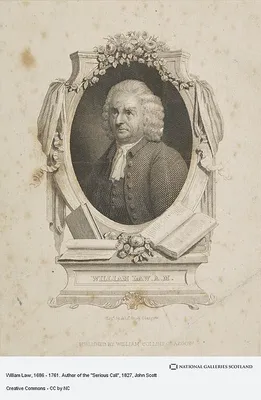
William Law
William Law was an English priest and writer whose theological works influenced spiritual movements and thinkers.
William Law was an English priest and theologian born in 1686. He was compelled to leave his position at Emmanuel College, Cambridge, due to his conscience, which prevented him from swearing allegiance to King George I. This stance, aligning him with the non-jurors who remained loyal to the House of Stuart, led to the loss of his academic post. Subsequently, Law pursued a career as a curate and later as a private tutor and prolific writer, dedicating himself to spiritual guidance and theological discourse. His profound integrity and mystical writings significantly impacted the evangelistic movements of his era and influenced prominent Enlightenment figures like Samuel Johnson and Edward Gibbon. His influential book, "A Serious Call to a Devout and Holy Life" (1729), deeply moved figures such as William Wilberforce, and his spiritual writings continue to be published today.
Law's intellectual journey also involved a deep engagement with the mystical writings of Jakob Böhme, whom he admired greatly. This influence became evident in his later works, which explored themes of spiritual regeneration and divine knowledge. Despite a notable disagreement with John Wesley regarding Böhme's philosophy, Law continued his spiritual explorations. His legacy extends to his posthumous involvement in a significant edition of Böhme's works, which was admired by later figures like Samuel Taylor Coleridge and William Blake.
Early Life and Non-Juror Stance
Born in 1686, William Law entered Emmanuel College, Cambridge, in 1705, where he studied classical subjects, Hebrew, philosophy, and mathematics. He was elected a fellow in 1711 and ordained. However, his academic career was cut short by the accession of King George I in 1714. Law's deeply held principles prevented him from taking the required oaths of allegiance to the new Hanoverian monarch and abjuration of the Stuarts, marking him as a non-juror. This refusal led to the forfeiture of his fellowship. He served briefly as a curate before becoming a tutor to the son of Edward Gibbon (father of the historian). For over a decade, Law resided at the Gibbon household in Putney, acting as a spiritual advisor to the family and many visitors, including prominent figures like John and Charles Wesley, and the poet John Byrom.
Theological and Philosophical Contributions
Law was an active participant in theological debates of his time. His "Three Letters to the Bishop of Bangor" (1717) contributed to the Bangorian controversy from a high-church perspective. He also defended morality in "Remarks on Mandeville's Fable of the Bees" (1723) and explored the role of reason in faith in "Case of Reason" (1732), which anticipated arguments found in Joseph Butler's "Analogy of Religion." His writings on practical divinity, particularly "A Practical Treatise Upon Christian Perfection" (1726) and "A Serious Call to a Devout and Holy Life" (1729), were highly influential, shaping the course of the great evangelistic revival. These works were acknowledged as foundational by leaders such as John and Charles Wesley and George Whitefield, and they also garnered praise from secular thinkers like Samuel Johnson and Edward Gibbon.
Mystical Influences and Later Writings
In his later years, Law developed a profound admiration for the German Christian mystic Jakob Böhme. His attention was drawn to Böhme's work through the writings of Pierre Poiret and discussions with George Cheyne. This influence infused Law's writings with a mystical dimension, evident in works like "A Demonstration of the Errors of a late Book" (1737) and "The Grounds and Reasons of Christian Regeneration" (1739). His exploration of Böhme's ideas led to a temporary estrangement from John Wesley, who criticized Law's interpretation. Law continued to delve into Böhme's philosophy, producing "The Spirit of Prayer" (1749–1750), "The Way to Divine Knowledge" (1752), and "The Spirit of Love" (1752–1754), the latter serving as preparation for his translation of Böhme's works. He taught himself German to read Böhme's original texts.
Key Ideas
- Non-juror principles: refusal to swear allegiance to the Hanoverian monarch due to loyalty to the Stuarts.
- Mystical theology: deep engagement with the spiritual and philosophical ideas of Jakob Böhme.
- Practical divinity: emphasis on devout living and spiritual perfection as central to Christian life.
Notable Quotes
“I have scarce met with a greater friend to darkness except 'the illuminated Jacob Behmen'. But, Sir, have you not done him an irreparable injury? I do not mean by misrepresenting his sentiments; (though some of his profound admirers are positive that you misunderstand and murder him throughout) but by dragging him out of his awful obscurity; by pouring light upon his venerable darkness. Men may admire the deepness of the well, and the excellence of the water it contains: But if some officious person puts a light into it, it will appear to be both very shallow and very dirty. I could not have borne to spend so many words on so egregious trifles, but that they are mischievous trifles: ... bad philosophy has, by insensible degrees, paved the way for bad divinity.”
Books by William Law
3 free public domain books · Read online or download