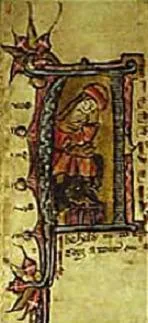
William Langland
William Langland is the presumed author of Piers Plowman, a complex allegorical poem exploring religious themes.
William Langland is believed to be the author of the Middle English allegorical poem "Piers Plowman," a significant work exploring diverse religious ideas. While much of his life remains obscure, evidence suggests he was born in the West Midlands of England around 1330. The poem itself, written around 1377, contains internal clues pointing to this region, particularly the Malvern Hills, and uses a dialect consistent with the area. A fifteenth-century note identifies his father as Stacy de Rokayle, and potential birthplaces include Cleobury Mortimer, Shropshire. Langland is thought to have died between 1385 and 1386, based on contemporary manuscript annotations. Much of what is understood about Langland's life is inferred from "Piers Plowman," though the distinction between the narrator's experiences and reality is often blurred, making direct biographical reconstruction challenging. His sophisticated religious knowledge suggests a connection to the clergy, though his exact role is unclear; he may have been an unbeneficed clerk or an itinerant scholar. The poem's anticlerical sentiments and its translation of cloistered concepts into layman's terms highlight its accessible yet profound spiritual commentary.
Authorship and "Piers Plowman"
William Langland is primarily recognized as the author of "Piers Plowman," an extensive allegorical poem written in Middle English alliterative verse. This work delves into a wide array of religious themes, aiming to translate complex theological language and concepts from monastic settings into understandable symbols and imagery for the general populace. The poem's attribution to Langland is largely based on manuscript evidence, including a note in a Dublin manuscript that names him as Willielmi de Langland, son of Stacy de Rokayle. The poem itself contains a passage where the narrator states his name is "longe wille," which is interpreted by some as a coded reference to the poet. While this attribution has been widely accepted since the 1920s, some scholarly debate continues regarding its certainty.
Life and Origins
Biographical details concerning William Langland are scarce and largely reconstructed from internal evidence within "Piers Plowman." He is believed to have been born in the West Midlands of England around 1330. This is supported by the narrator's account of receiving his first vision near the Malvern Hills and the poem's West Midland dialect. His father was reportedly Stacy de Rokayle, and potential birthplaces include Cleobury Mortimer, Shropshire, or possibly Ledbury, Herefordshire, or Great Malvern, Worcestershire. Langland likely died around 1385 or 1386, as suggested by a contemporary manuscript note referencing the death of an author named Will. He may have been associated with Woodhouse Friary near his presumed birthplace.
Social and Religious Context
The life of William Langland, as inferred from "Piers Plowman," suggests a complex social and religious position. Passages in the poem describe the narrator as a "loller" or idler living in London, with a wife and child, and earning a living by reciting prayers. However, the line between allegory and autobiography is blurred, and these descriptions might be literary conventions. Langland's profound religious knowledge indicates some connection to the clergy, but his specific affiliation remains uncertain. He is often considered part of a group of unbeneficed clerks on the fringes of society, or possibly an itinerant scholar exchanging writing for sustenance. While "Piers Plowman" shares concerns with John Wycliffe, such as questioning indulgences and clerical corruption, direct links to Wycliffism are debated, and Langland's theological views on sacraments did not echo Wycliffe's distinctive teachings.
Key Ideas
- Allegory with complex religious themes
- Translation of cloistered religious concepts for lay understanding
- Social commentary on late medieval England
- Spiritual allegory and moral instruction
Notable Quotes
“whan this werke was wrouyt, ere Wille myte aspie/ Deth delt him a dent and drof him to the erthe/ And is closed vnder clom”
“I have lived in londe [...] my name is longe wille”
Books by William Langland
2 free public domain books · Read online or download