William Lang
Daniel Lang was an American journalist and author known for his New Yorker reporting on moral responsibility and societal issues.
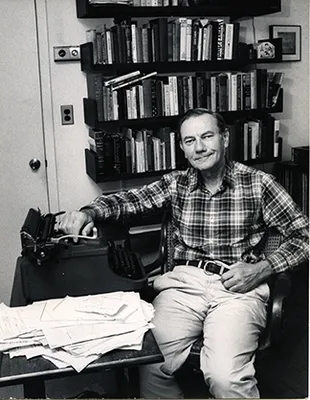
Daniel Lang, born in New York City to Hungarian Jewish immigrants, was a prolific journalist and author who spent most of his career as a staff writer for The New Yorker. His early life on the Lower East Side was documented in a semi-autobiographical story. After attending the University of Wisconsin, Lang worked as a sociologist before transitioning to journalism, meeting and marrying fellow reporter Margaret Altschul. He joined The New Yorker in 1941 and remained with the publication until his death in 1981.
Throughout his career, Lang covered significant global events, serving as a war correspondent in Europe and North Africa. He developed a keen interest in the moral implications of scientific advancements, particularly concerning atomic testing. During the Vietnam War, he exposed military atrocities against civilians, and later in his career, he interviewed former members of the Third Reich about their complicity in evil. His work, often collected into books, was recognized for its moral weight, directness, and exploration of the human conscience.
Journalistic Focus and Moral Inquiry
Daniel Lang's extensive career at The New Yorker was characterized by a deep engagement with the ethical dimensions of contemporary events. He consistently explored how individuals navigate complex moral landscapes, particularly in the context of war and technological advancement. His reporting on atomic testing, for instance, delved into the responsibilities of scientists, while his work during the Vietnam War brought to light the ethical quandaries of conflict and its impact on civilian populations. Lang’s later interviews with Germans involved in the Third Reich further underscored his preoccupation with individual complicity in historical atrocities, examining themes of denial and the refusal to confront reality.
Literary Contributions and Style
Beyond his impactful journalism, Daniel Lang also explored various literary forms, including poetry, children's literature, and short stories, and even contributed an opera libretto. Many of his New Yorker articles were compiled into books and translated into multiple languages, demonstrating their international reach. His writing was described by former editor William Shawn as having "moral weight" and being a "student of the conscience." John Hersey noted Lang's focus on significant subjects and his direct, unexaggerated approach, which allowed readers to connect with people facing major historical challenges. His article "The Bank Drama" is notably credited with inspiring the term "Stockholm syndrome."
Key Ideas
- Moral responsibility of individuals in societal and historical events
- Ethical implications of scientific advancements, particularly nuclear technology
- The nature of complicity in evil through denial and non-acknowledgement of reality
- The conscience as a subject of journalistic and literary exploration
Notable Quotes
“He was one of the most steadfast and talented of our reportorial writers. His writings invariably had moral weight. He was a student of the conscience. Implicit in every piece he wrote was a controlling idea, but he never lapsed into abstraction. He tried very hard to understand the people he wrote about, and far more often than not he succeeded.”
“He arrived in our offices one day in 1941, shortly before the United States entered the Second World War, with an impressive sheaf of clippings of articles he had written for the New York Post. He was immediately taken onto the staff and soon wrote his first Reporter-at-Large piece on the British American Ambulance Corps.”
Books by William Lang
4 free public domain books · Read online or download