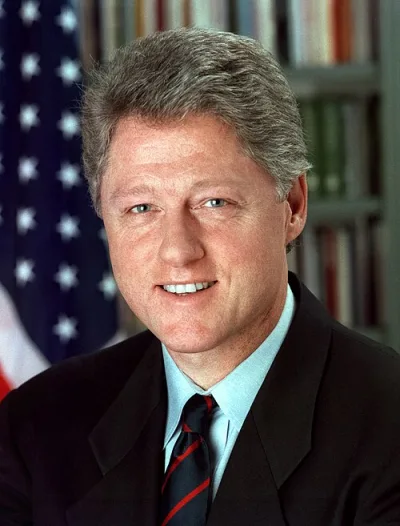
William Jefferson Clinton was the 42nd U.S. President, known for his centrist policies and navigating economic expansion and foreign conflicts.
William Jefferson Clinton, born August 19, 1946, served as the 42nd President of the United States from 1993 to 2001. A lawyer and politician from Arkansas, he held positions as Attorney General and Governor before his presidency. His political philosophy, termed "Clintonism," emphasized a "Third Way" approach that influenced Democratic Party history for decades. Clinton's presidency coincided with a significant period of peacetime economic growth in the United States. He signed into law major legislation such as the North American Free Trade Agreement and the Brady Handgun Violence Prevention Act. However, he also faced significant challenges, including the failure of his national health care reform plan and a controversial compromise regarding LGBTQ+ military service. His tenure saw an ideological shift towards more conservative domestic policies in his second term, alongside continued support for liberal initiatives.
In foreign policy, Clinton's administration engaged in military interventions in the Balkans, promoted NATO expansion, and supported groups opposing Saddam Hussein in Iraq. He also played a role in advancing peace processes in the Middle East and Northern Ireland. His second term was notably marked by impeachment proceedings stemming from his relationship with a White House intern, though he was acquitted by the Senate. Despite these controversies, Clinton left office with high approval ratings. Post-presidency, he has remained active in humanitarian work through the Clinton Foundation and engaged in political advocacy, notably for his wife's presidential campaigns.
Early Life and Education
Born William Jefferson Blythe III in Hope, Arkansas, Clinton's early life was shaped by his mother's pursuit of nursing and his grandparents' grocery business. After his mother remarried Roger Clinton Sr., he adopted the surname Clinton. He attended segregated schools in Hot Springs, where he excelled as a student leader, musician, and member of the Order of DeMolay, a Masonic youth group. Clinton briefly considered a career in music but was drawn to law and politics, influenced by a mock trial in Latin class. Key formative experiences included meeting President John F. Kennedy and witnessing Martin Luther King Jr.'s "I Have a Dream" speech, which solidified his desire for public service. He pursued higher education at Georgetown University on scholarships, graduating in 1968, and was active in student government and as an intern for Senator J. William Fulbright. He later attended Oxford University on a Rhodes Scholarship, where he studied politics and philosophy, and then Yale Law School, where he met his future wife, Hillary Rodham.
Political Philosophy and Presidency
Clinton's political approach, known as "Clintonism," represented a "Third Way" that blended centrist and progressive ideas, significantly shaping the Democratic Party. Elected president in 1992, he presided over a period of sustained economic expansion, the longest at that time. His administration enacted landmark legislation including NAFTA and measures addressing gun violence and crime. However, his ambitious national health care reform plan did not pass, and he navigated complex social issues, such as allowing gay and lesbian individuals to serve in the military. Following the 1994 midterm elections, Clinton's domestic policy evolved, incorporating more conservative elements like welfare reform and financial deregulation, while still supporting programs like the State Children's Health Insurance Program. He appointed two justices, Ruth Bader Ginsburg and Stephen Breyer, to the U.S. Supreme Court.
Foreign Policy and Later Career
In foreign affairs, Clinton's presidency saw U.S. military involvement in the Bosnian and Kosovo conflicts, leading to the Dayton Peace Agreement. He advocated for NATO's expansion into Eastern Europe and supported efforts to counter Saddam Hussein in Iraq. His administration also engaged in diplomatic initiatives, including the Oslo I Accord and the Camp David Summit, aimed at resolving the Israeli-Palestinian conflict, and assisted the Northern Ireland peace process. Re-elected in 1996, his second term was overshadowed by impeachment proceedings related to a scandal involving a White House intern, though he was ultimately acquitted by the Senate. Post-presidency, Clinton has focused on humanitarian efforts through the Clinton Foundation, addressing global issues like HIV/AIDS and climate change, and served as a UN special envoy to Haiti. He remains an influential figure in Democratic politics.
Key Ideas
- Third Way political philosophy (Clintonism)
- Centrist approach blending Democratic and Republican policies
- Focus on economic expansion and fiscal responsibility
- Navigating complex foreign policy challenges and peace processes
Books by
3 free public domain books · Read online or download