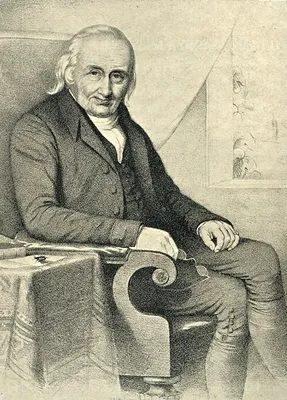
William Josiah Sutton
William Kirby was an English entomologist, clergyman, and founding member of scientific societies, known for his influential work on insects.
William Kirby (1759–1850) was an English entomologist and clergyman who made significant contributions to the study of natural history. Born in Suffolk, he studied at Cambridge and took holy orders, spending most of his life as a country rector. Kirby was a founding member of the Linnean Society and a Fellow of the Royal Society, embodying the "parson-naturalist" tradition. His early interest in natural history was nurtured through correspondence and excursions with fellow naturalists. He was a descendant of notable Suffolk figures, including the topographer John Kirby.
Kirby's most significant scientific work was the four-volume "Introduction to Entomology," co-authored with William Spence, which became a widely respected text. His "Monographia Apum Angliae" (1802) was the first scientific treatise on English bees and reflected his belief that the study of nature could lead to religious understanding. He also contributed to scientific expeditions, including Arctic exploration, and helped establish natural history museums and the Entomological Society of London. His later work, "On the Power Wisdom and Goodness of God," was part of the esteemed Bridgewater Treatises.
Early Life and Scientific Beginnings
William Kirby was born in Witnesham, Suffolk, in 1759, into a family with connections to topography and art. After studying at Ipswich School and Caius College, Cambridge, he entered the clergy in 1782. He served as a country rector in Barham, Suffolk, for nearly seven decades. His passion for natural history was ignited through friendships with figures like Nicholas Gwynn and Sir James Edward Smith. Kirby became an active participant in scientific circles, joining early excursions with naturalists such as Charles Sutton and Thomas Marsham. His affiliation with the Linnean Society began early, as he is listed among its original fellows. His scientific contributions commenced with papers presented to societies, starting with one on new species of "Hirudo" in 1793.
Pioneering Entomological Works
Kirby's seminal work, "Monographia Apum Angliae," published in 1802, was the first comprehensive scientific study of English bees. This publication brought him international recognition among entomologists. He viewed the study of nature as intertwined with religious devotion, believing that observing God's creation revealed divine truths. This perspective is evident in his stated purpose for the bee monograph: to encourage naturalists to see God's glory in the natural world. His extensive correspondence with leading scientists of the era, including Alexander Macleay and Johan Christian Fabricius, facilitated the exchange of knowledge and specimens. Many of the bee species he documented were discovered in his own parish.
Landmark Publications and Contributions
The "Introduction to Entomology," a four-volume collaboration with William Spence, stands as one of Kirby's most influential achievements. Planned from 1808 and published between 1815 and 1826, the work was extensively illustrated by John Curtis and proved highly popular, reaching its seventh edition by 1856. Kirby also contributed to broader scientific endeavors, including the natural history sections of reports from polar expeditions and Sir John Franklin's Arctic explorations. In 1835, he authored one of the prestigious Bridgewater Treatises, "On the Power Wisdom and Goodness of God. As Manifested in the Creation of Animals and in Their History, Habits and Instincts," further solidifying his reputation as a prominent naturalist.
Founding Scientific Institutions
Beyond his research and writing, Kirby played a crucial role in establishing scientific institutions. He was instrumental in the founding of the Entomological Society of London in 1833, serving as its Honorary President for life and donating his extensive insect collection, amassed over four decades. He also actively supported the development of museums, assisting in the arrangement of specimens at Norwich Museum and co-founding an early museum at Ipswich's Literary Institute in 1832, to which he donated a herbarium and fossils. He later served as the first President of the Ipswich Museum from 1847 until his death.
Key Ideas
- The study of nature as a means to understand divine wisdom and goodness.
- The interconnectedness of scientific observation and religious devotion.
- The importance of documenting and classifying insect species for scientific advancement.
Notable Quotes
“The author of Scripture is also the author of Nature: and this visible world, by types indeed, and by symbols, declares the same truths as the Bible does by words. To make the naturalist a religious man – to turn his attention to the glory of God, that he may declare his works, and in the study of his creatures may see the loving-kindness of the Lord – may this in some measure be the fruit of my work…”
Books by William Josiah Sutton
2 free public domain books · Read online or download