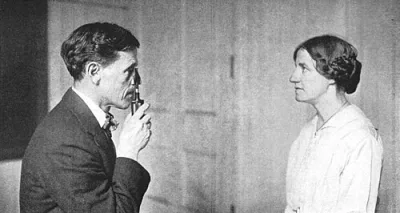
William Horatio Bates
William Horatio Bates developed an unproven vision improvement method based on relieving 'mental strain' and eye muscle tension.
William Horatio Bates, an eye doctor active in the early 20th century, proposed an alternative therapy for vision improvement that has since been widely discredited by the scientific and medical communities. Bates believed that vision problems stemmed from 'mental strain' that caused the eye's external muscles to function abnormally, leading to incorrect focusing. He theorized that by releasing this strain, vision could be restored without the need for corrective lenses. His approach involved various exercises and practices aimed at achieving this relaxation.
Bates' theories about how the eye focuses, particularly his rejection of the ciliary muscle's role and his proposal that external muscles control focus by altering eyeball shape, contradicted established ophthalmological understanding. His methods, including 'palming' (covering closed eyes), visualization of black objects, and eye movements, were presented as cures for a range of conditions, including myopia, glaucoma, and cataracts. Despite claims of success in his publications and those of his assistant, Bates' work faced significant criticism for being unscientific, potentially dangerous, and for making unsubstantiated claims, leading to regulatory action.
The Bates Method: Core Beliefs and Practices
William Horatio Bates proposed that poor eyesight was primarily caused by muscular tension around the eyeball, which he linked to 'mental strain.' He rejected the conventional understanding that the eye's internal ciliary muscle adjusts the lens for focus, instead positing that external muscles altered the eyeball's shape. Bates believed that relieving this perceived strain through specific techniques would naturally correct vision. His methods included 'palming,' where individuals would cover their closed eyes with their hands to achieve deep relaxation, and visualization exercises, such as imagining black letters or simple shapes. He also promoted 'shifting,' which involved moving the eyes to create an illusion of objects moving in the opposite direction, believing this stimulated proper eye function.
Critiques and Scientific Rejection
The Bates method has been largely dismissed by the medical and scientific communities. Optometry professor Elwin Marg noted in 1952 that most of Bates' claims and theories were considered false by visual scientists. Research has shown that exercises cannot alter the eye's refractive power, and the human eyeball is too rigid to change shape as Bates suggested for focusing. Furthermore, aspects of the Bates method carry risks, such as potential eye damage from excessive sun exposure ('sunning') or neglecting necessary corrective lenses, which could lead to accidents or allow serious eye conditions to worsen without proper medical attention. The Federal Trade Commission also took action against Bates for false advertising.
Historical Context and Dissemination
Bates first published his ideas in the late 19th and early 20th centuries, claiming success in reversing nearsightedness and improving vision in schoolchildren. He collaborated with Bernarr Macfadden, a physical culture advocate, on a correspondence course for vision training, which was later criticized as dangerous quackery by the American Medical Association. Bates also published a magazine, 'Better Eyesight,' and his own book, 'The Cure of Imperfect Sight by Treatment Without Glasses.' His assistant, Emily Lierman, continued to promote these methods, with some claims extending to curing conditions like glaucoma and cataracts, further drawing criticism for exaggerated and unsubstantiated therapeutic benefits.
Key Ideas
- Vision problems are caused by 'mental strain' leading to abnormal eye muscle tension.
- Relieving 'mental strain' and eye tension can cure imperfect sight without glasses.
- External eye muscles, not the ciliary muscle, are responsible for focusing by altering eyeball shape.
- Techniques like palming, visualization, and eye movement exercises promote relaxation and improve vision.
Notable Quotes
“mental strain”
“Most of his claims and almost all of his theories have been considered false by practically all visual scientists.”
“eye crutches”
Books by William Horatio Bates
2 free public domain books · Read online or download