✍️ Author Biography
William Edward Soothill
📅 1861 – 1935
🌍 American
📚 2 free books
⭐ Known for: The student's four thousand [characters] a...
William Edward Soothill was a missionary and sinologist known for his translations of Confucian texts and studies of Chinese Buddhism.
William Edward Soothill (1861-1935) was a prominent British scholar of China, initially serving as a Methodist missionary for nearly three decades in Wenzhou. During his extensive time in China, he established various educational and religious institutions, including a hospital, a training college, and numerous preaching stations. His commitment to education extended to leadership roles, such as becoming President of the Imperial University at Shanxi. Upon returning to England, Soothill transitioned to academia, accepting a professorship in Chinese at the University of Oxford. His contributions were recognized by the Republic of China with the Order of Wen-Hu and through his involvement in delegations concerning the Boxer Rebellion indemnities.
Soothill's scholarly legacy is primarily built upon his significant contributions to making Chinese philosophical and religious texts accessible to a Western audience. He is particularly renowned for his English translation of The Analects of Confucius, a foundational text of Confucianism. Furthermore, his Dictionary of Chinese Buddhist Terms, which included Sanskrit and English equivalents, served as an important resource for understanding Buddhist terminology. His later work, The Hall of Light, explored early Chinese kingship. Soothill's family also had connections to Chinese studies, with his daughter Dorothea Hosie being a notable author on the subject.
Missionary Work and Educational Foundations
Born in Yorkshire in 1861, William Edward Soothill dedicated a significant portion of his life to missionary work in China. After matriculating at London University and entering the ministry of the United Methodist Free Church, he arrived in China in 1882. For 29 years, he was based in Wenzhou, where he was actively involved in establishing and developing various institutions. His efforts included founding a hospital, a training college, and numerous schools, alongside establishing 200 preaching stations. This extensive work laid a foundation for education and religious outreach in the region. His commitment to higher education was further demonstrated when he served as President of the Imperial University at Shanxi in 1911.
Academic Career and Scholarly Contributions
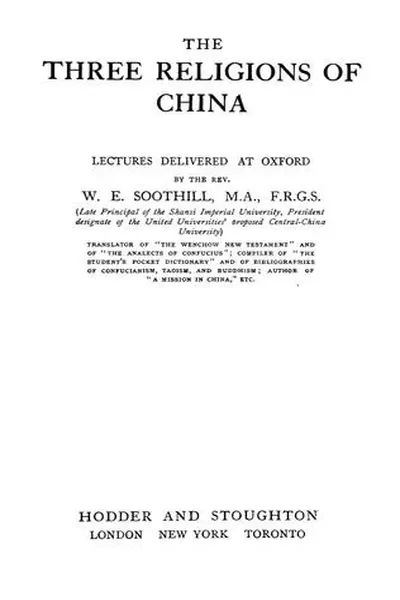
Following his return to England in 1920, William Edward Soothill's career took an academic turn. He was appointed Professor of Chinese at the prestigious University of Oxford, solidifying his position as a leading British sinologist. His academic work focused on translating and interpreting key Chinese texts for a Western readership. He is best known for his English translation of The Analects of Confucius, a seminal work of Chinese philosophy. Another highly regarded contribution is his Dictionary of Chinese Buddhist Terms, which provided essential equivalents in Sanskrit and English, along with a Sanskrit-Pali Index, facilitating deeper study of Buddhist concepts. His later works explored Chinese history and culture, including 'The Three Religions of China' and 'A History of China'.
Recognition and Later Life
William Edward Soothill's extensive service and scholarly achievements garnered significant recognition. In 1921, the Republic of China awarded him the Order of Wen-Hu (third class) for his contributions related to the Chinese Labour Corps in France. He also participated in diplomatic efforts, being a member of Lord Willingdon's delegation in 1926 concerning the settlement of Boxer Rebellion indemnities. Soothill passed away in 1935. His family continued to be involved in Chinese studies; his wife, Lucy Farrar, wrote about their experiences in China, and their daughter, Dorothea Hosie, became an author of books on China.