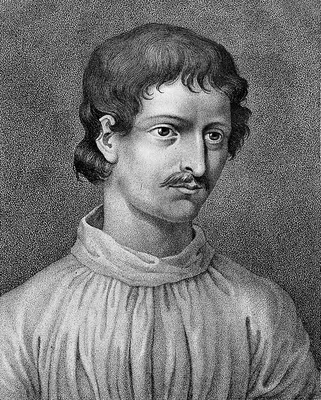
Giordano Bruno was an Italian philosopher, cosmologist, and esotericist executed for heresy, known for his infinite universe theories and mystic approach.
Giordano Bruno, born Filippo Bruno in 1548, was an Italian philosopher, poet, alchemist, astronomer, and esotericist. He is recognized for his cosmological theories, which expanded upon the Copernican model, proposing that stars were distant suns with planets and that the universe was infinite and without a center. Bruno also embraced Hermeticism and a mystical exploration of the cosmos, suggesting the possibility of life on other planets. His philosophical and religious views, including pantheism and metempsychosis (reincarnation), led to his trial for heresy by the Roman Inquisition. He was found guilty of denying core Catholic doctrines and was burned at the stake in 1600. Despite his execution, Bruno gained significant posthumous fame, particularly as a martyr for free thought and emerging sciences in the 19th and early 20th centuries.
Beyond cosmology, Bruno was a noted practitioner of the art of memory, developing mnemonic techniques. His intellectual influences included Neoplatonism, Renaissance Hermeticism, and ancient Greek philosophy. Bruno's life was marked by extensive travel and intellectual activity across Europe, including periods in Geneva, Paris, and England. His controversial ideas and outspoken nature frequently led to conflict, ultimately culminating in his trial and execution. His case remains a significant event in the history of intellectual freedom and the development of scientific thought.
Cosmological and Esoteric Theories
Giordano Bruno was a prominent philosopher and esotericist whose cosmological views significantly challenged the prevailing scientific and religious paradigms of his time. He is best known for extending the Copernican model, proposing that the stars were not fixed points but distant suns, each potentially orbited by its own planets. This concept of cosmic pluralism raised the possibility of life existing beyond Earth. Bruno also asserted that the universe was infinite, lacking any central point, a radical departure from the geocentric and finite universe models. His approach to understanding the universe was deeply mystical, drawing from Hermeticism and emphasizing a spiritual connection to the cosmos. These ideas, alongside his pantheistic beliefs and teachings on reincarnation, placed him at odds with the Catholic Church.
Heresy Trial and Execution
Bruno's heterodox views on religion and cosmology led to his confrontation with the Roman Inquisition. He was accused of denying fundamental Catholic doctrines, including eternal damnation, the Trinity, the divinity of Christ, the virginity of Mary, and transubstantiation. His pantheistic outlook and belief in metempsychosis, the transmigration of souls, were particularly contentious. After a lengthy trial, the Inquisition declared him guilty. In 1600, Giordano Bruno was publicly burned at the stake in Rome's Campo de' Fiori. While some historians suggest his trial was primarily a response to his religious and metaphysical beliefs rather than his astronomical theories, his case is widely regarded as a pivotal moment in the history of free thought and the nascent scientific revolution.
The Art of Memory and Intellectual Influences
In addition to his cosmological and theological works, Giordano Bruno was a recognized master of the art of memory. He developed and wrote extensively on mnemonic techniques, which involved complex systems for organizing knowledge and enhancing recollection. Historians suggest his intellectual development was shaped by various traditions, including the philosophy of Empedocles, Neoplatonism, Renaissance Hermeticism, and ancient legends associated with Hermes Trismegistus. Bruno also explored a qualitative approach to mathematics and applied geometric spatial concepts to language. His writings on memory, such as 'The Shadows of Ideas' and 'The Art of Memory,' were based on his models of organized knowledge, contrasting with the more logic-focused mnemonic methods popular at the time.
Key Ideas
- Cosmic pluralism (stars are suns with planets, possibility of extraterrestrial life)
- Infinite universe with no center
- Pantheism
- Metempsychosis (reincarnation of the soul)
- Mnemonic techniques (Art of Memory)
Books by
2 free public domain books · Read online or download