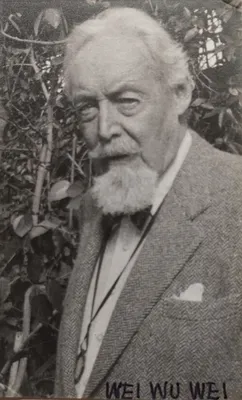
Wei Wu Wei
Terence Gray, writing as Wei Wu Wei, authored influential books on Taoist philosophy after a career in experimental theatre.
Terence James Stannus Gray (1895–1986) was an English theatre producer and author who later adopted the pen name Wei Wu Wei to publish works on Taoist philosophy. Initially known for establishing and directing the experimental Cambridge Festival Theatre between 1926 and 1933, Gray produced over 100 plays, often focusing on non-naturalistic styles and movement. Despite critical division and collaborators departing due to his uncompromising approach, the theatre attracted audiences.
Gray's early life included studies in Egyptology, leading to expeditions and publications on ancient Egyptian history. He also maintained a family interest in horse racing. Later in life, after abandoning theatre, Gray's focus shifted to philosophy and metaphysics. He traveled extensively in Asia, including a period at Ramana Maharshi's ashram. Under the pseudonym Wei Wu Wei, he published eight books and articles between 1958 and 1974, exploring Taoist concepts, notably 'wu wei' (non-action). His identity as Wei Wu Wei was kept private during publication, as explained in the preface to his first book. His writings have influenced figures like G. Spencer-Brown and are discussed in later publications.
Early Life and Theatrical Career
Born Terence James Stannus Gray in 1895, he came from an established Anglo-Irish family and was raised on an estate near Cambridge. His education included Ascham St Vincent's School, Eton, and Oxford. Early interests led to publications on ancient Egyptian history. Gray later founded and produced plays at the Cambridge Festival Theatre from 1926 to 1933. With no prior theatrical experience, he transformed an existing venue into an experimental playhouse, staging over 100 productions. His work often prioritized movement and visual spectacle over dialogue, leading to divided critical reception. Gray's uncompromising nature and a significant speech impediment reportedly presented challenges during his theatrical tenure, ultimately leading him to leave the field in 1933.
Egyptology and Later Interests
Gray's engagement with Egyptology began with studies at University College, London, followed by participation in four distinct archaeological expeditions to Egypt between 1924 and 1949. These expeditions took him to various sites, including El Badari, the Western Desert for rock inscriptions, and regions along the Nile's 4th Cataract. His early academic pursuits also included publishing two books on ancient Egyptian history and culture in 1923. In his later years, Gray resided in Monaco with his second wife, Georgian princess Natalie Margaret Imeretinsky. He also maintained his family's involvement in horse racing; his horse Zarathustra famously won the Ascot Gold Cup in 1957.
Philosophical Writings as Wei Wu Wei
Following his departure from the theatre, Gray's intellectual focus shifted towards philosophy and metaphysics. This transition involved extensive travel, including time spent at Ramana Maharshi's ashram in India. It was during this period that he began writing under the pseudonym Wei Wu Wei, a term signifying 'action that is non-action' in Taoism. Between 1958 and 1974, he published eight books and numerous articles exploring these themes, deliberately keeping his authorship concealed. His seminal work, 'Fingers Pointing Towards the Moon,' published in 1958, outlined his reasons for this anonymity. Wei Wu Wei's teachings on the 'Negative Way' and non-volitional living have resonated with subsequent thinkers and practitioners in esoteric and philosophical circles.
Key Ideas
- Wu Wei (non-action): The central Taoist concept of effortless action or action in accordance with the natural flow of things.
- The Negative Way: A philosophical approach emphasizing what something is not, often leading to deeper understanding through negation.
- Non-Volitional Living: Living in alignment with natural processes, without forceful or ego-driven intent.
Books by Wei Wu Wei
2 free public domain books · Read online or download