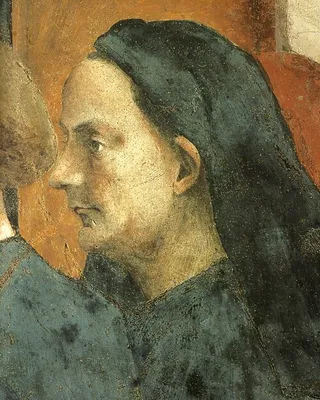
Wayne Saalman
Filippo Brunelleschi was a pioneering Renaissance architect, engineer, and designer, famous for Florence Cathedral's dome and linear perspective.
Filippo Brunelleschi, born in Florence in 1377, was a pivotal figure in the Italian Renaissance, recognized as a founder of Renaissance architecture and the first modern engineer. Initially trained as a goldsmith and sculptor, he achieved master status in 1398 and joined a prestigious guild. Although he participated in a competition for the Florence Baptistery doors, he ultimately shifted his focus to architecture and optics, continuing to accept sculpture commissions for a period.
Brunelleschi's architectural career was significantly influenced by his study of classical Roman ruins, which he visited, possibly with Donatello, between 1402 and 1404. This exploration informed his design principles, emphasizing clear forms, balanced elements, and the integration of space. His early architectural projects, such as the Foundling Hospital (Ospedale degli Innocenti) and the Basilica of San Lorenzo, showcased innovative uses of classical elements, establishing new standards for Renaissance design. His most celebrated achievement is the dome of the Florence Cathedral, a monumental feat of engineering and design.
Early Life and Artistic Beginnings
Born in Florence in 1377, Filippo Brunelleschi came from a well-off family. His father, a notary, intended for Filippo to follow his career path, providing him with a literary and mathematical education. However, Filippo's artistic inclinations led him, at age fifteen, to apprentice as a goldsmith and bronze sculptor. By December 1398, he had become a master and joined the Arte della Seta, a prominent guild that encompassed various metal crafts. His early surviving works include small silver sculptures created for Pistoia Cathedral between 1399 and 1400. During this period, he also briefly served on Florentine government councils.
The Baptistery Doors Competition and Shift to Architecture
In 1401, Florence held a competition for a new set of bronze doors for the Baptistery, with Brunelleschi among the seven contestants. The task was to create a bronze panel depicting the Sacrifice of Isaac, harmonizing with existing doors. While the jury found it difficult to choose between Brunelleschi and his rival, Lorenzo Ghiberti, suggesting collaboration, Brunelleschi refused to cede full control. This led to Ghiberti being awarded the commission. Although he continued to receive sculpture commissions until around 1416, Brunelleschi eventually abandoned sculpture to concentrate entirely on architecture and optics.
Rediscovery of Antiquity and Architectural Innovation
Between 1402 and 1404, Brunelleschi, likely accompanied by his friend Donatello, visited Rome to study its ancient ruins. This period of intense engagement with classical architecture profoundly influenced his design philosophy, leading to principles of clear spatial organization, minimized distinct elements, and balanced forms. His architectural work, beginning with the Foundling Hospital (1419–c. 1445), demonstrated a sophisticated application of classical motifs, such as the loggia with its arches and columns, which became a model for subsequent Renaissance buildings. This project, along with others like the Basilica of San Lorenzo, showcased his innovative use of classical elements to create harmonious and balanced spaces, establishing new standards for Renaissance architecture.
Engineering the Florence Cathedral Dome
Brunelleschi's most famous accomplishment is the design and construction of the dome for Florence Cathedral (Santa Maria del Fiore), a project initiated around 1420 and completed after his death. The proposed dome was exceptionally large, surpassing the ancient Pantheon. Brunelleschi devised novel engineering solutions and construction techniques to erect this massive structure, earning him recognition as a pioneering engineer. His innovative approach to the dome, along with his development of mathematical perspective, significantly impacted art, architecture, and the burgeoning scientific thought of the era.
Key Ideas
- Founding father of Renaissance architecture
- First modern engineer, planner, and construction supervisor
- Mathematical technique of linear perspective
- Innovative use of classical architectural elements
- Balancing architectural elements for homogeneous space
Books by Wayne Saalman
2 free public domain books · Read online or download