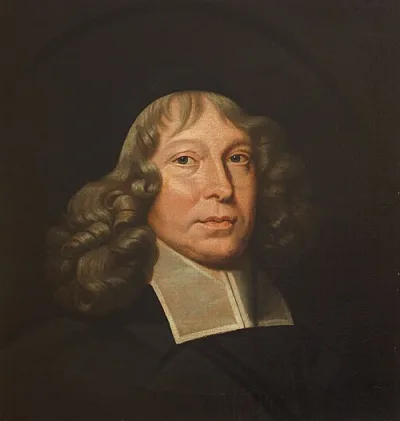
Scottish theologian Samuel Rutherford was a prominent minister and influential writer known for his theological and political works.
Samuel Rutherford was a Scottish Presbyterian minister and theologian born around 1600. He received his education at Jedburgh Grammar School and the University of Edinburgh. After a brief period as a regent at Edinburgh, he faced accusations of misconduct that may have stemmed from marrying without proper authority. He was later appointed to Anwoth Kirk, where he was known for his dedicated pastoral work. Rutherford's theological stances led to confrontations with church authorities, including a prohibition from ministerial duties and a period of residence in Aberdeen. During this time, he produced much of his significant writing. He returned to active ministry and became a key figure in the Scottish church, serving as a commissioner to the Westminster Assembly. Despite numerous offers to teach abroad and in other Scottish universities, he remained in Scotland, eventually becoming Principal of St. Mary's College, St. Andrews. He was a staunch supporter of the Protester faction within the Presbyterian church. Following the Restoration, his writings, particularly 'Lex, Rex', were condemned and burned, and he faced persecution before his death in 1661.
Theological and Political Thought
Rutherford was a significant political thinker, most notably for his book 'Lex, Rex' (1644), which advocated for limited government and constitutionalism, justifying resistance to unlawful authority. This work, however, did not equate to a belief in civil liberty as commonly understood; Rutherford upheld the doctrine of the Two Kingdoms, separating church and state but holding the monarch responsible for upholding true religion. He was a fervent proponent of divine right Presbyterianism, engaging in written debates with New England Independents. Conversely, Rutherford was a staunch opponent of liberty of conscience, authoring 'A Free Disputation against Pretended Liberty of Conscience' (1649), which defended religious persecution and drew criticism from figures like John Milton.
Literary and Spiritual Influence
Samuel Rutherford's 'Letters', though posthumously published in 1664, achieved immense renown, with some critics likening them to biblical inspiration. His writings were characterized by original thought, profound emotion, and imaginative language, often described as poetic and deeply spiritual. These letters are noted for their blend of hope and sorrow, capturing the pathos of both earthly existence and the afterlife. Beyond his letters, Rutherford also penned other devotional works such as 'Christ Dying and drawing Sinners to Himself' and 'The Trial and Triumph of Faith'. His legacy as a scholar, preacher, and writer left a lasting impact, with his name achieving a popular veneration that continues to this day.
Key Ideas
- Limited government and constitutionalism
- Justification of resistance to unlawful authority
- Two Kingdoms doctrine (separation of church and state)
- Divine right Presbyterianism
- Opposition to liberty of conscience and defense of religious persecution
Notable Quotes
“Acquainted with Emmanuel's Love”
“Glory shines in Immanuel's Land”
“such a book as Mr. Rutherford’s Letters, the world never saw the like”
“when we are dead and gone let the world know that Spurgeon held Rutherford's Letters to be the nearest thing to inspiration which can be found in all the writings of mere men”
“the letters flash upon the reader with original thoughts and abound in lofty feeling clothed in the radiant garb of imagination in which there is everything of poetry but the form”
Books by
7 free public domain books · Read online or download