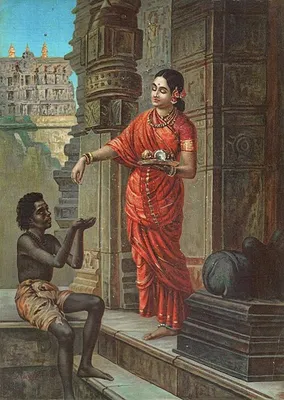
Vālmīki, Robert P. Goldman, Rosalind Lefeber
Mandodari, queen consort of Ravana, was a figure of beauty, piety, and loyalty in the Ramayana, often advising against her husband's destructive path.
Mandodari was the devoted queen consort of Ravana, the powerful king of Lanka, as depicted in the Hindu epic Ramayana. Daughter of the asura king Mayasura and the celestial nymph Hema, she was known for her exceptional beauty, righteousness, and unwavering loyalty to Ravana, despite his many flaws. She frequently urged him to follow a righteous path and return Sita to Rama, though her counsel was often ignored. Mandodari is recognized as one of the Panchakanya, whose names are considered purifying.
Her origin is described in various accounts, often involving divine intervention and transformation, including being born from a frog or sandalwood paste. Despite her husband's tyrannical actions, Mandodari remained a steadfast wife, even intervening to save Sita from Ravana's wrath on one occasion. During the great war, she continued to stand by Ravana and even advised her son, Indrajit, against fighting Rama. Following Ravana's demise, many versions suggest she married his brother, Vibhishana, in an arrangement described as a political necessity.
Origins and Divine Lineage
Mandodari's parentage is attributed to Mayasura, the king of the Asuras, and the apsara Hema. Various traditions offer different narratives for her birth. One account suggests she was adopted after being found in a well, originally a cursed apsara named Madhura who had a liaison with Shiva. Another version describes her creation from a doll by Shiva or from sandalwood paste by Vishnu. A recurring motif involves a frog, either as a form she was cursed into or as the origin of her name. These diverse origins highlight a mystical and transformative aspect to her being, predating her role as queen.
Queen of Lanka and Moral Compass
As Ravana's queen, Mandodari was renowned for her striking beauty, virtue, and devotion. She consistently acted as Ravana's moral conscience, urging him to abandon his unrighteous pursuits and to return Sita to Rama, a plea that went unheeded. Despite her husband's descent into wickedness, her love and loyalty remained steadfast. She is celebrated for her wisdom and piety, embodying a righteous presence within Ravana's court. Her character serves as a counterpoint to Ravana's destructive ambition, representing a path of dharma that was tragically overlooked.
Role in the Ramayana War
During the epic war between Rama and Ravana, Mandodari made several attempts to avert disaster, including advising Ravana not to engage in the final battle and cautioning her son, Indrajit, against fighting Rama. In some accounts, she is depicted as being physically humiliated by Angada or Hanuman, a consequence of Ravana's actions. A pivotal moment involves Hanuman tricking her into revealing the location of the magical arrow that ultimately killed Ravana. After Ravana's death, she is often portrayed as mourning his demise and subsequently marrying his brother, Vibhishana, a union seen as a political alliance to restore order.
Books by Vālmīki, Robert P. Goldman, Rosalind Lefeber
2 free public domain books · Read online or download