Vālmīki, Robert P. Goldman, Krishna Dharma
The Mahābhārata is an ancient Indian epic poem detailing a dynastic war, rich in philosophy and devotional content.
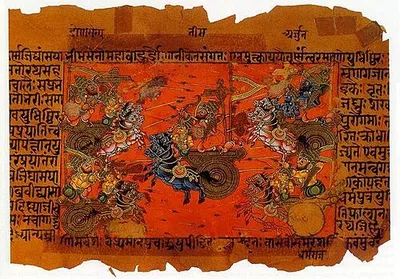
The Mahābhārata, meaning 'Great Bharata,' is one of ancient India's two major Sanskrit epics, revered in Hinduism alongside the Rāmāyaṇa. It is classified as a smriti text and falls under the category of Itihasas. The narrative centers on the Kurukshetra War, a conflict between two cousin factions, the Kauravas and the Pāṇḍavas, and its consequences. Beyond the war, the epic encompasses significant philosophical and devotional material, including discussions on the four aims of life (puruṣārtha). Notable works and stories embedded within it include the Bhagavad Gita and tales like Damayanti and Shakuntala.
Traditionally attributed to the sage Vyāsa, the Mahābhārata's composition is believed to have occurred between the 3rd century BCE and the 3rd century CE, with its final form emerging around the early Gupta period (4th century CE). It is the longest epic poem known, with its most extensive version containing over 100,000 verses, making it substantially longer than other classical epics. The text is sometimes referred to as the fifth Veda within the Indian tradition. Scholars have long studied its historical development and layered composition, with early Indologists sometimes describing its structure as chaotic, while others focused on identifying its earliest components.
Textual History and Structure
The Mahābhārata is traditionally ascribed to the sage Vyāsa, who is also a character within the epic. It is described as an itihasa, or history. The text employs a frametale structure, with stories nested within others. The epic's initial recitation is attributed to Vyāsa's disciple, Vaisampayana, to King Janamejaya, and later retold by Ugrashrava Sauti to a gathering of sages. Research indicates that elements of the Mahābhārata trace back to Vedic times, with its origins likely post-dating the early Vedic period and preceding the rise of the first Indian empire in the 3rd century BCE. It began as an orally transmitted tale, evolving over time. Scholars recognize at least three major redactions: Jaya (8,800 verses), Bharata (24,000 verses), and the Mahābhārata (over 100,000 verses). The text's compilation and additions likely occurred with formal principles in mind, emphasizing numbers like 18 and 12.
Philosophical and Devotional Content
The Mahābhārata is renowned for its profound philosophical and devotional content, extending far beyond its narrative of dynastic conflict. It extensively explores the concept of puruṣārtha, the four aims of human life: dharma (duty/righteousness), artha (prosperity/meaning), kama (pleasure/desire), and moksha (liberation/spiritual release). This exploration offers guidance on ethical conduct, societal order, and spiritual understanding. Embedded within the epic are crucial philosophical dialogues and teachings, most notably the Bhagavad Gita, which presents a dialogue between Lord Krishna and the warrior Arjuna on duty, devotion, and the nature of reality. The epic also delves into themes of karma, reincarnation, and the path to self-realization, making it a significant source for spiritual wisdom and ethical reflection within Hinduism.
Historical Context and Evolution
The Mahābhārata's composition is estimated to have spanned from the 3rd century BCE to the 3rd century CE, with its final form solidifying around the 4th century CE. The earliest preserved parts are not thought to be much older than 400 BCE. The epic's roots are believed to lie in orally transmitted stories from around the 8th or 9th century BCE. The historical backdrop is the Iron Age in India, specifically the Kuru kingdom, which was a significant political center between approximately 1200 and 800 BCE. While the historicity of the central Kurukshetra War remains uncertain, many historians place it in the 10th century BCE. The text's evolution involved significant accretion and redaction, with scholars identifying layers that may extend back to Vedic times. Early external references, such as in Panini's 4th-century BCE grammar, suggest the existence of early versions of the text by that period.
Key Ideas
- Itihasa (history/epic)
- Smriti (texts remembered)
- Puruṣārtha (four aims of life: dharma, artha, kama, moksha)
- Guru–shishya tradition (teacher-student lineage)
- Story within a story structure (frametales)
- Karma and reincarnation
Books by Vālmīki, Robert P. Goldman, Krishna Dharma
2 free public domain books · Read online or download