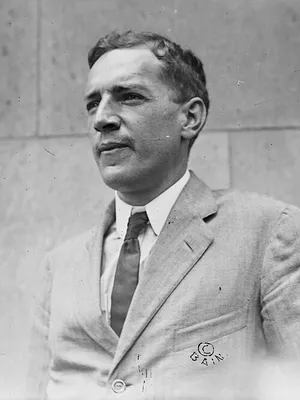
Upton Sinclair
Upton Sinclair was a prolific author and activist known for exposing societal ills and exploring psychic phenomena.
Upton Sinclair (1878-1968) was a prolific American author, journalist, and political activist whose nearly 100 works spanned various genres. He gained significant fame in the early 20th century for his muckraking novels, most notably "The Jungle" (1906), which revealed appalling conditions in the meatpacking industry and contributed to new federal regulations. His writing often explored the perspectives of both the working class and industrialists during the Progressive Era, with other notable works like "King Coal" and "Oil!" examining labor in key industries.
Beyond his social critiques, Sinclair was also a political figure, running for office multiple times as a Socialist and later as a Democrat, advocating for progressive reforms like his "End Poverty in California" campaign. He was awarded the Pulitzer Prize for Fiction in 1943. Interestingly, Sinclair also delved into occult phenomena, experimenting with telepathy and documenting his wife's experiences in his book "Mental Radio," which influenced the establishment of a parapsychology department at Duke University.
Literary Exposés and Social Commentary
Upton Sinclair's literary career was largely defined by his role as a muckraker, using fiction to expose societal injustices. His most impactful work, "The Jungle," published in 1906, detailed the unsanitary and exploitative conditions within Chicago's meatpacking plants. The public outcry following its release was instrumental in the passage of the Pure Food and Drug Act and the Meat Inspection Act. Sinclair's commitment to revealing hidden truths extended to journalism itself with "The Brass Check" (1919), which highlighted journalistic malpractice and preceded the creation of the first code of ethics for journalists. He consistently wrote from the viewpoints of both laborers and industrialists, offering a comprehensive look at the American industrial landscape through novels like "King Coal" (1917), "Oil!" (1927), and "The Flivver King" (1937), which examined the coal, oil, and automotive industries respectively.
Political Activism and Campaigns
A committed socialist, Sinclair actively participated in politics throughout his life, advocating for significant social and economic reforms. He ran for Congress multiple times as a Socialist Party nominee and later, as a Democrat, he became the party's candidate for governor of California in 1934. His gubernatorial campaign was centered around the "End Poverty in California" (EPIC) movement, a platform designed to address the economic hardships of the Great Depression. Despite garnering a substantial number of votes, he was ultimately defeated in that election. His political endeavors often put him at odds with established powers, including Hollywood studio executives who opposed his progressive agenda.
Exploration of the Esoteric
Beyond his well-known social and political writings, Upton Sinclair also cultivated an interest in the esoteric and paranormal. He conducted experiments related to psychic phenomena, particularly telepathy. His book "Mental Radio" (1930) documented his wife Mary Craig Sinclair's alleged telepathic abilities and experiences. This work garnered attention from figures like psychologist William McDougall, who, inspired by Sinclair's research, helped establish the parapsychology department at Duke University, marking a significant, albeit indirect, contribution to the academic study of the unexplained.
Key Ideas
- Muckraking journalism through fiction to expose societal ills
- Critique of labor conditions in industrial sectors
- Advocacy for progressive and socialist reforms
- Exploration of telepathy and psychic phenomena
Notable Quotes
“It is difficult to get a man to understand something, when his salary depends upon his not understanding it.”
Books by Upton Sinclair
2 free public domain books · Read online or download