TransAlchemy
Alchemy is an ancient tradition blending philosophy and protoscientific practices, seeking material and spiritual perfection through symbolic processes.
Alchemy, originating from ancient natural philosophy, was practiced across China, India, the Muslim world, and Europe. It involved attempts to purify and perfect materials, aiming for goals like transmuting base metals into gold, creating an elixir of immortality, and achieving the perfection of the human body and soul through a "Great Work." Alchemists developed laboratory techniques and terminology, often guarding their knowledge through secrecy and symbolic language. While its practical applications are studied in terms of early chemistry and medicine, its esoteric and spiritual dimensions are of interest to historians of esotericism and psychologists. The subject has also significantly influenced literature and the arts.
Origins and Etymology
The term "alchemy" derives from the Arabic "al-kīmiyā," itself a borrowing from the Late Greek "khēmeía." This Greek term has several proposed origins, including a reference to metallic casting or the Egyptian word "kēme," meaning "black earth," referring to the fertile Nile valley. Alchemists referred to their craft as "the Art" or "Knowledge," characterizing it as mystic, sacred, or divine. The practice itself spans approximately four millennia and three continents, with major independent strands in China, India, and the West. Western alchemy's roots are often traced to Hellenistic Egypt, particularly Alexandria, where it emerged from Egyptian goldsmithing, Greek philosophy, and various religious traditions.
Alchemical Pursuits and Symbolism
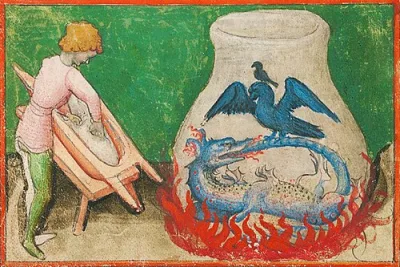
Central to alchemical endeavors was the purification, maturation, and perfection of substances. Common objectives included chrysopoeia (transmuting base metals like lead into gold), the creation of an elixir of immortality, and the development of panaceas. The ultimate goal was often seen as the "Great Work," a process believed to perfect both the human body and soul, conceptually linked to the creation of the philosopher's stone. Alchemists employed a basic set of laboratory techniques, theories, and terms, many of which persist today. They adhered to the ancient Greek concept of four elements and often concealed their work using ciphers and cryptic symbolism. Figures like Hermes Trismegistus, a composite of the Egyptian god Thoth and the Greek Hermes, became a central mythological figure, with texts attributed to him, known as the Hermetica, closely linked to Western alchemical philosophy.
The Hermetica and the Emerald Tablet
The Hermetica, a collection of texts attributed to Hermes Trismegistus, played a crucial role in Western alchemy, sometimes leading practitioners to refer to their philosophy as "Hermetic." These texts are broadly divided into "technical" and "religio-philosophical" categories, with the technical Hermetica encompassing alchemy, astrology, medicine, and magic. The oldest parts of these technical texts likely date back to the 2nd or 3rd century BC. Many of these works were translated and expanded upon through Arabic and Latin, becoming widely circulated during the Middle Ages. The most renowned among these is the Emerald Tablet, a concise and enigmatic text. Its earliest known versions appear in Arabic treatises between the 8th and 10th centuries AD. Latin translations from the 12th century onwards introduced the Emerald Tablet to Europe, where it was interpreted by commentators like Ortolanus as a foundational text for alchemical instructions, particularly concerning the creation of the philosopher's stone and gold.
Historical Development and Legacy
The history of Western alchemy is complex, with early practices possibly dating back to metallurgy around 3500 BC. However, many ancient alchemical writings were lost, notably when Roman emperor Diocletian ordered the destruction of alchemical books following a revolt in Alexandria around AD 292. The 12th-century translations of medieval Islamic scientific works and the rediscovery of Aristotelian philosophy spurred a significant flourishing of Latin alchemy in Europe. This late medieval tradition profoundly influenced the development of early modern science, particularly in the fields of chemistry and medicine. Modern scholarship often distinguishes between the exoteric (practical) and esoteric (spiritual) aspects of alchemy, though some scholars argue these should be viewed as interconnected.
Key Ideas
- Chrysopoeia: The transmutation of base metals into noble metals, especially gold.
- Elixir of Immortality: The creation of a substance granting eternal life.
- Panacea: The creation of a universal cure for all diseases.
- Magnum Opus (Great Work): The process of perfecting the human body and soul.
- Philosopher's Stone: A legendary substance associated with transmutation and perfection.
- Four Elements: Adherence to the ancient Greek concept that all matter is composed of earth, air, fire, and water.
- Hermetic Philosophy: A philosophical system derived from the Hermetica, closely linked to alchemy.
Books by TransAlchemy
3 free public domain books · Read online or download