Thomas Cattoi
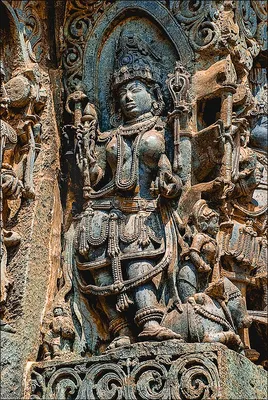
Shakti, a central concept in Hinduism, represents the feminine divine energy that sustains existence and is foundational to goddess worship.
Shakti, meaning 'energy' or 'power' in Sanskrit, is a fundamental concept in Hinduism representing the universal feminine force that underlies and sustains all existence. It is often personified as a goddess and is considered the complementary power to male deities, embodying the active, creative principle of the universe. The worship of Shakti, particularly prominent in Tantric Shaktism, views her as the supreme deity, akin to Brahman. The traditions associated with Shakti worship are known as Shakta, with Shakta Pithas being significant pilgrimage sites.
The concept of Shakti has ancient origins, with evidence of goddess worship dating back to the Paleolithic era and the Indus Valley Civilization. While Vedic literature mentions goddesses as personifications of divine aspects or consorts of gods, the idea of Shakti as an independent, supreme feminine power evolved over centuries. Later Hindu texts, particularly the Puranas and Tantras, solidified the identification of goddesses with Shakti, recognizing her as the source of creation and the dynamic, feminine principle of the cosmos. This development laid the groundwork for the rich traditions of goddess worship found in Hinduism.
The Nature and Significance of Shakti
Shakti, a Sanskrit term signifying 'energy,' 'ability,' or 'power,' is a core concept in Hinduism denoting the supreme feminine force that permeates and sustains all existence. It is conceived as the active, dynamic, and creative principle, often personified as a goddess who acts as the complementary power to male deities. In Tantric Shaktism, Shakti holds the foremost position as the supreme deity, comparable to Brahman. In Puranic Hinduism, Shakti represents the feminine principle (prakriti), which, in conjunction with the masculine principle (purusha), creates the universe. The term 'Shakta' refers to adherents and traditions devoted to Shakti worship, with 'Shakti Pithas' marking sacred sites associated with this divine energy.
Origins and Evolution of Shakti Worship
The origins of Shakti worship are traced back to pre-Vedic times, with archaeological findings suggesting mother goddess veneration as early as the Paleolithic period and the Indus Valley Civilization. While early Vedic scriptures acknowledged goddesses, they were often depicted as consorts or personifications of divine aspects. The Rigveda contains hymns, such as the Devī Sūkta addressed to Vāc (Speech), that began to present goddesses as all-powerful, pervasive beings. A significant development occurred when terms like 'Śacī,' representing Indra's power, hinted at a divine power separate from a deity. Over time, particularly during the classical period (c. 200 BCE – 1200 CE) and through the Puranas, the concept of Shakti as the supreme, independent feminine divine energy became fully established, leading to the prominent identification of goddesses with this cosmic force.
Philosophical Underpinnings and Later Developments
The philosophical underpinnings of Shakti are deeply intertwined with Upanishadic thought. The concept of Brahman, the gender-neutral Absolute, influenced later ideas about Shakti. While early Upanishads focused on an unknowable, transcendental Absolute, later texts introduced Saguna Brahman (manifest Absolute), allowing for theistic relationships. The Shakta Upanishads specifically built upon these ideas, positing Shakti as the divine feminine energy inherent in the Absolute. During the classical period, the Puranas further developed these concepts, often portraying goddesses as inseparable from their consorts and as embodiments of energy (Shakti), primordial matter (prakriti), and illusion (maya), thereby establishing the goddess as the source of manifest creation.
Key Ideas
- Shakti: The universal feminine energy, power, or divine force that sustains existence.
- Feminine Principle: Shakti represents prakriti, the active, creative, and dynamic aspect of the cosmos.
- Complementary Duality: Shakti is often seen as the feminine counterpart to the masculine principle (purusha), essential for creation.
- Supreme Goddess: In Tantric Shaktism, Shakti is the foremost deity, equivalent to Brahman.
- Shakta Tradition: The religious paths and people dedicated to the worship of Shakti.
- Shakti Pithas: Sacred sites believed to be seats of Shakti's power.
Books by Thomas Cattoi
2 free public domain books · Read online or download