Sumano Ajahn, Bhikkhu., Ajahn Bhikkhu Sumano, Emily Popp
The term 'monkey mind' originates from Buddhist concepts describing a restless, uncontrolled state of thought.
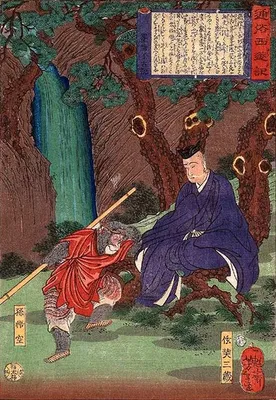
The concept of 'monkey mind' originates from the Chinese term 'xinyuan' (心猿), literally meaning 'heart-mind monkey.' This Buddhist idea describes a mind that is restless, erratic, and difficult to control. The metaphor is not exclusive to Buddhism, appearing in Taoism, Neo-Confucianism, and various forms of Chinese literature and art. It is often paired with 'idea horse' (yima or iba, 意馬), representing wandering thoughts, forming idioms like 'xinyuanyima' (心猿意馬) and 'ibashin'en' (意馬心猿) in Chinese and Japanese respectively, illustrating the connection between a restless mind and unfocused thoughts.
The 'monkey' and 'horse' components are central to this metaphor. The 'monkey' (yuan/en) symbolizes agility and unpredictability, while the 'horse' (ma/ba) represents the swiftness and directionality of thoughts. In Chinese mythology, gibbons were thought to absorb life force, and various 'monkey' exercises and martial arts styles exist. The 'horse' is seen as a divine animal, linked to dragons and sacred offerings. The combination signifies the challenge of taming the mind's inherent restlessness and wandering nature, a core theme in meditation practices aimed at achieving focus and control.
Origins and Buddhist Context
The term 'monkey mind' originates from the Chinese 'xinyuan' (心猿) and its Japanese equivalent 'shin'en' (心猿), both translating to 'heart-mind monkey.' This Buddhist concept captures the nature of a mind characterized by restlessness, fickleness, and a lack of control over its own thoughts. This metaphor is found across various Buddhist traditions, including Chan, Zen, Consciousness-only, Pure Land, and Shingon. Beyond Buddhism, it has been adopted into Taoism, Neo-Confucianism, and is prevalent in Chinese poetry, theater, and literature. The expression frequently appears in conjunction with 'idea horse' (yima or iba, 意馬), forming paired idioms that highlight the interconnectedness of a restless mind and wandering thoughts, such as the Chinese 'xinyuanyima' and the Japanese 'ibashin'en'.
Metaphorical Components: Mind, Thought, Monkey, and Horse
The metaphor is built upon four key elements: 'xin' or 'shin' (心) for heart/mind, 'yi' or 'i' (意) for thought/idea, 'yuan' or 'en' (猿) for monkey/ape, and 'ma' or 'ba' (馬) for horse. The 'heart/mind' (xin/shin) is understood as the seat of consciousness and emotion, while 'thought/idea' (yi/i) refers to the content and direction of cognition. The 'monkey' (yuan/en) symbolizes the erratic, jumping nature of thoughts, while the 'horse' (ma/ba) represents their speed and potential for uncontrolled movement. In Buddhist contexts, 'xin/shin' often corresponds to Sanskrit 'citta' (mind/consciousness), and 'yi/i' to 'manas' (mental organ/deliberation). The combination illustrates the challenge of achieving mental stillness by acknowledging and working with the mind's natural tendency towards distraction.
Cultural and Esoteric Significance
The 'monkey mind' metaphor extends beyond mere description to practical application in spiritual disciplines. In Taoist breath meditation, for instance, the practice of 'xinyuanyima' involves focusing the mind on counting breaths to prevent wandering. Achieving unity between the heart and breathing is described as 'locking up the monkey heart and tying up the running horse of intellect.' This highlights the esoteric goal of gaining mastery over mental states. Furthermore, animal metaphors are common across cultures; while 'monkey' can mean 'mimic' universally, specific cultural associations exist. In Chinese mythology, gibbons were associated with longevity and absorbing life force, and 'monkey' exercises are mentioned in ancient texts. The 'horse' is often viewed as a divine creature, linked to dragons and sacred traditions in both Chinese and Japanese cultures. The interplay of these animal symbols underscores the dynamic and often wild nature of the uncultivated mind.
Key Ideas
- Monkey Mind (Xinyuan/Shin'en): A Buddhist concept describing a restless, uncontrolled state of thought.
- Idea Horse (Yima/Iba): Represents wandering thoughts, often paired with 'monkey mind' to illustrate mental distraction.
- Xin (心): Heart/mind, the seat of consciousness and emotion.
- Yi (意): Thought/idea, the cognitive content and direction.
- Yuan/En (猿): Monkey/ape, symbolizing the erratic nature of thoughts.
- Ma/Ba (馬): Horse, representing the speed and movement of thoughts.
- Mental Discipline: Practices aimed at controlling and focusing the mind, as seen in Taoist meditation.
Books by Sumano Ajahn, Bhikkhu., Ajahn Bhikkhu Sumano, Emily Popp
2 free public domain books · Read online or download