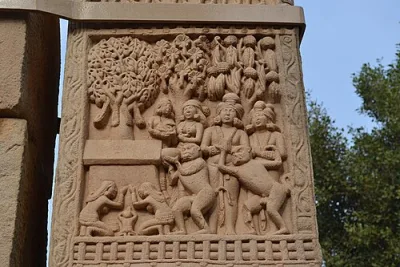
Nirvana signifies the cessation of suffering and rebirth, achieved by extinguishing mental afflictions, with diverse interpretations across Buddhist traditions.
Nirvana, also known as nibbana, represents the ultimate spiritual goal in Buddhism, signifying the extinguishing of mental passions, grasping, and the suffering they cause. It leads to liberation from the cycle of rebirth (samsara) and is considered the highest religious aim. Often described as unconditioned and beyond conventional reality, nirvana transcends dualities like existence and non-existence, and is beyond conceptual understanding.
Interpretations of nirvana vary, commonly involving the extinction of the 'three poisons' – greed, aversion, and ignorance – which are likened to fires. Different Buddhist schools have debated whether nirvana is a transcendent reality or simply the cessation of suffering. The concept is also linked to insights into non-self (anatta) and emptiness (sunyata). Traditional distinctions include nirvana with remainder (during life) and final nirvana (after death), with Mahayana Buddhism further defining a 'non-abiding' nirvana essential for guiding others.
Etymology and Core Meanings
The term 'nirvana' carries multiple etymological interpretations, each offering a nuanced understanding of its meaning. One prominent interpretation derives from the root 'vā,' meaning 'to blow,' suggesting 'blowing out' or 'quenching' the fires of passion, greed, and ignorance. This 'blowing out' is not annihilation but the cessation of mental agitation. Another etymology links 'nirvana' to 'vana,' meaning 'desire' or 'thirst,' thus signifying a state free from craving. Further interpretations involve 'vana' as 'weaving,' implying the abandonment of the desires that weave the cycle of existence, or as 'woods/forest,' symbolizing escape from the 'forest of defilements.' Some scholars propose it relates to 'unbinding' or even 'uncovering' a true nature beyond conditioned phenomena, though these are debated.
Interpretations and Distinctions
Within Buddhism, nirvana is fundamentally understood as the cessation of suffering ('dukkha') and the cycle of rebirth ('samsara'). Early Buddhist texts often describe it as the extinction of the 'three poisons' (greed, hatred, ignorance), which are analogous to the Vedic ritual fires that a householder maintained. While some schools viewed nirvana as an existing transcendent state, others saw it as merely the absence of suffering. The concept is closely associated with the Four Noble Truths, particularly the cessation of suffering, and the Eightfold Path.
Traditional distinctions include 'sopadhishesa-nirvana' (nirvana with a remainder), experienced during life by an enlightened being, and 'parinirvana' or 'anupadhishesa-nirvana' (nirvana without remainder), attained after death. Mahayana Buddhism introduces 'non-abiding nirvana,' where Buddhas manifest in the world to guide beings while retaining a transcendent dimension, avoiding both complete cessation and fixation in a transcendent state.
Synonyms and Related Concepts
Nirvana is often used interchangeably with terms like 'moksha' and 'vimutti,' both signifying release or deliverance from suffering. The Pali canon distinguishes between 'ceto-vimutti' (freedom of mind through meditation) and 'pañña-vimutti' (freedom through understanding or insight). While 'ceto-vimutti' offers qualified release, 'pañña-vimutti' represents the ultimate liberation from rebirth. The integration of these concepts suggests a developing emphasis within Buddhism on insight meditation alongside meditative absorption. The term 'uttari-vimutti' (highest liberation) also appears in early texts, referring to ultimate freedom from the cycle of rebirth.
Key Ideas
- Extinguishing of passions, grasping, and suffering.
- Liberation from the cycle of rebirth (samsara).
- Unconditioned and transcendent state beyond dualities.
- Extinction of the 'three poisons' (greed, aversion, ignorance).
- Distinction between nirvana with and without remainder.
- Mahayana concept of 'non-abiding nirvana'.
Books by
2 free public domain books · Read online or download