Shane McCorristine
Isidore Lucien Ducasse, under the pseudonym Comte de Lautréamont, authored 'Les Chants de Maldoror,' a dark prose poem influencing Surrealism.
'Les Chants de Maldoror,' written by Isidore Lucien Ducasse (Comte de Lautréamont), is a French prose poem published between 1868 and 1869. The work centers on Maldoror, an evil and misanthropic character who rejects conventional morality. Initially overlooked, it was later recognized and championed by Surrealist artists in the early 20th century, who were drawn to its transgressive, violent, and absurd themes. The text is structured into six parts and subdivided into chapters, often featuring lengthy, unconventional sentences and a shifting narrative voice that can create ambiguity between the narrator and Maldoror himself. The book's episodes are frequently surreal and disconnected, exploring themes of inhumanity, urban-rural contrasts, homosexuality, blasphemy, and violence. The final part shifts in style, presenting a more linear narrative that culminates in a violent act interpreted as a critique of traditional literary forms.
Structure and Thematic Exploration
'Les Chants de Maldoror' is composed of six distinct parts, further divided into sixty chapters. The prose often employs long, complex sentences and minimal paragraph breaks, hinting at a stream-of-consciousness or automatic writing style. The narrative perspective shifts between first and third person, leading to potential confusion about the narrator's identity and reliability, often blurring the lines with the central figure, Maldoror. Many chapters present isolated, often bizarre episodes, such as a funeral procession or a man tormented by a spider. Recurring themes include a fascination with animalistic ferocity, celebrated for its inhumanity, and a contrast between urban and rural settings. The work also delves into blasphemy, homosexuality, and violent acts, particularly against children.
Influence and Legacy
Despite its obscurity upon initial publication, 'Les Chants de Maldoror' gained significant posthumous recognition. The Surrealist movement embraced the work in the early 20th century, drawn to its radical themes and experimental style. Key figures like Louis Aragon, André Breton, and Salvador Dalí were notably influenced. The book's impact extended to other artistic spheres, with illustrations by artists such as Odilon Redon, Salvador Dalí, and René Magritte. It is considered a precursor to Symbolism, Dada, and Surrealism. Ducasse's other work, 'Poésies,' offers a contrasting humanistic tone and may be seen as a response to the dark visions presented in 'Maldoror.'
Source Material and Publication History
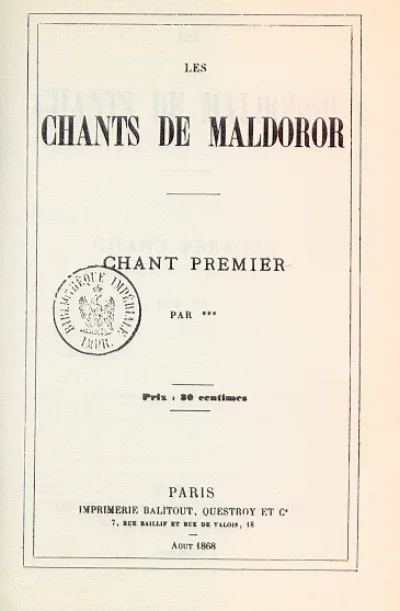
The text of 'Les Chants de Maldoror' incorporates material drawn from natural history encyclopedias, notably from Buffon and his collaborators. This source material is sometimes integrated in unusual ways, as seen in a passage describing bird families and a man's 'bird-brain.' The first canto was published anonymously in 1868, with the complete work appearing in 1869 under the pseudonym Comte de Lautréamont. The publisher, Albert Lacroix, refused to distribute it due to fear of legal repercussions. Ducasse's other writings, 'Poésies I' and 'Poésies II,' were published without a pseudonym shortly before his death in 1870. The complete 'Maldoror' was never published during Ducasse's lifetime, with later editions appearing with new covers or excerpts.
Key Ideas
- Rejection of conventional morality and embrace of evil through the character Maldoror.
- Exploration of inhumanity and animalistic traits as a source of admiration.
- Juxtaposition of urban and rural environments.
- Critique of traditional literary forms through experimental prose and structure.
Notable Quotes
“It is not right that everyone should read the pages which follow; only a few will be able to savour this bitter fruit with impunity. Consequently, shrinking soul, turn on your heels and go back before penetrating further into such uncharted, perilous wastelands.”
“The shining worm, to me: 'You, take a stone and kill her.' 'Why?' I asked. And it said to me: 'Beware, look to your safety, for you are the weaker and I the stronger. Her name is Prostitution.' With tears in my eyes and my heart full of rage, I felt an unknown strength rising within me. I took hold of a huge stone; after many attempts, I managed to lift it as far as my chest. Then, with my arms, I put it on my shoulders. I climbed the mountain until I reached the top: from there, I hurled the stone on to the shining worm, crushing it.”
“The swimmer is now in the presence of the female shark he has saved. They look into each other's eyes for some minutes, each astonished to find such ferocity in the other's eyes. They swim around keeping each other in sight, and each one saying to himself: 'I have been mistaken; here is one more evil than I.' Then by common accord they glide towards one another underwater, the female shark using its fins, Maldoror cleaving the waves with his arms; and they hold their breath in deep veneration, each one wishing to gaze for the first time upon the other, his living portrait. When they are three yards apart they suddenly and spontaneously fall upon one another like two lovers and embrace with dignity and gratitude, clasping each other as tenderly as brother and sister. Carnal desire follows this demonstration of friendship.”
“I dreamt I had entered the body of a hog, that I could not easily get out again, and that I was wallowing in the filthiest slime. Was it a kind of reward? My dearest wish had been granted; I no longer belonged to mankind.”
Books by Shane McCorristine
5 free public domain books · Read online or download