Seminar on Buddhist Literary Heritage in India: Text and Context (2005 Calcutta, India)
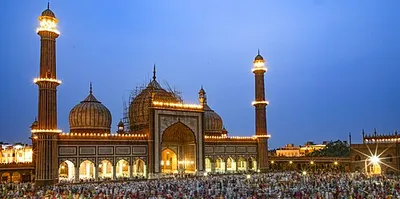
Islam arrived in India through trade routes, with early mosques built by Arab merchants, becoming a significant part of India's heritage.
Islam is the second-largest religion in India, with a substantial population identifying as Muslim. Its arrival in India is linked to ancient trade routes, with early interactions occurring along the Gujarat and Malabar coasts shortly after the religion's inception. Arab traders played a crucial role, bringing Islam to India and establishing some of the earliest mosques, with traditions suggesting conversions and mosque constructions dating back to the 7th century CE.
While the majority of Indian Muslims belong to local ethnic groups, genetic studies indicate minimal gene flow from the Middle East and Central Asia. The social structure within Indian Muslim communities, particularly the distinction between Ashrafs and Ajlafs, contrasts with the Islamic principle of equality. Despite this, the religion has deeply integrated into India's cultural and religious landscape over centuries, with significant historical presence and diverse community origins.
Early Arrival and Establishment
Islam's presence in India dates back to the early centuries of its existence, primarily facilitated by Arab traders. These merchants, who frequented India's western coast for centuries, introduced Islam to coastal communities. Historical accounts and popular traditions point to the construction of some of the earliest mosques in India between 610 and 630 CE along the Gujarat and Malabar coasts, with significant sites in Kerala, Tamil Nadu, and Gujarat. The Cheraman Juma Mosque in Kerala is often cited as one of the first, with legends linking its establishment to the conversion of a local ruler during the Prophet Muhammad's lifetime. These early interactions led to the formation of distinct Muslim communities through trade, settlement, and intermarriage with local populations.
Social Stratification and Islamic Principles
Within Indian Muslim society, a social hierarchy has developed, with groups like the Ashraf claiming foreign ancestry and higher status, while Ajlafs are often seen as converts from local traditions with lower status. This stratification, however, stands in contrast to core Islamic teachings emphasizing the equality of all believers, regardless of origin or lineage, as articulated in texts like the Quran and Hadith, and in Muhammad's Farewell Sermon. While orthodox doctrine promotes unity, the practice of marrying within one's social group remains prevalent in India. Genetic research suggests that while most Indian Muslims are genetically similar to local non-Muslim populations, some minor gene flow from outside the subcontinent has been detected.
Cultural and Intellectual Exchange
The interaction between Arab and Indian cultures predates Islam and continued with its arrival. Arab traders not only facilitated the spread of Islam but also contributed to significant cultural and intellectual exchange. Indian numeral systems were transmitted to the Middle East and Europe via Arab scholars. Furthermore, numerous Sanskrit texts were translated into Arabic as early as the 8th century, contributing to the body of knowledge that influenced Islamic civilization and, subsequently, the European Renaissance. This reciprocal exchange highlights the deep historical connections between the regions.
Key Ideas
- Early spread of Islam through Arab trade routes.
- Construction of early mosques in India.
- Social hierarchy within Indian Muslim communities (Ashraf/Ajlaf).
- Contrast between social hierarchy and Islamic principles of equality.
- Cultural and intellectual exchange between Arab and Indian civilizations.
Books by Seminar on Buddhist Literary Heritage in India: Text and Context (2005 Calcutta, India)
2 free public domain books · Read online or download