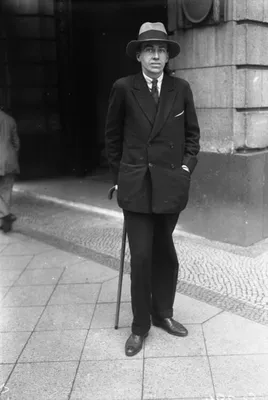
Scott Medbury
Cornelius Vanderbilt IV was a journalist, author, and publisher who rejected high society, served in WWI and WWII, and made an early anti-Nazi film.
Cornelius Vanderbilt IV, born in 1898, was a member of the prominent Vanderbilt family who chose a path distinct from his social standing. Despite his parents' objections, he pursued a career in journalism, working for major newspapers and launching several publications. However, his publishing ventures faced significant financial losses.
Vanderbilt's life was marked by a rejection of the high society into which he was born, as detailed in his autobiography. He served in both World War I and World War II, achieving officer rank. Notably, he produced one of the first anti-Nazi films, "Hitler's Reign of Terror," in 1934, which faced censorship and was believed lost for decades. He also authored other books, including a biography of his mother and a novel that was adapted into a film. He was married seven times and had no children, passing away in 1974.
Early Life and Military Service
Born in 1898, Cornelius Vanderbilt IV was the son of Cornelius Vanderbilt III and Grace Graham Wilson. Known as "Cornelius Vanderbilt, Jr." or "Neil" within his family, he attended preparatory schools and was on track for Yale. His education was interrupted by World War I, and he enlisted in the U.S. Army in 1917. He served in France as an orderly and driver, even briefly chauffeuring General Douglas Haig. Upon returning to the U.S. in late 1918, he was promoted to wagoner and served as a transportation instructor before his honorable discharge in early 1919. He was subsequently commissioned as a 2nd lieutenant in the Infantry Officers Reserve Corps.
Journalism and Publishing Career
Against his parents' wishes, who disdained the press, Vanderbilt pursued a career in journalism. He worked for the New York Herald and The New York Times. In the early 1920s, he founded several newspapers, including the Los Angeles Illustrated Daily News and the San Francisco Illustrated Daily Herald. This publishing enterprise, however, proved financially unsuccessful, resulting in substantial losses. He later worked as an assistant managing editor for the New York Daily Mirror. In 1926, he famously interviewed Benito Mussolini, an encounter that led to a fatal car accident involving a child, a story Vanderbilt later recounted, causing diplomatic repercussions.
Film and Autobiographical Works
Vanderbilt's most significant contribution to film was the 1934 anti-Nazi documentary "Hitler's Reign of Terror." Made covertly during a visit to Nazi Germany, it was an early exposé of the regime and its persecution of Jews. The film faced censorship and was considered lost until a copy was discovered in Belgium. In 1935, he published his autobiography, "Farewell to Fifth Avenue," which critiqued the superficiality of high society and recounted his diverse experiences, including encounters with notable figures like Franklin Roosevelt, Kaiser Wilhelm, and Al Capone. He also authored "Queen of the Golden Age," a biography of his mother, and "Personal Experiences of a Cub Reporter."
Later Life and World War II Service
In 1938, Vanderbilt joined the U.S. Army Reserve and was on active duty as a major in the Intelligence Corps by 1941, receiving commendation from the FBI. He was discharged in 1943 due to poor health. In his later years, he settled in Reno, Nevada, continuing to write and lecture. He was a supporter of Israel and held a vice president position at Airtronics International Corporation. Vanderbilt was married seven times and had no children, passing away in 1974.
Key Ideas
- Critique of high society and its artificiality
- Early anti-Nazi sentiment and documentation
Books by Scott Medbury
2 free public domain books · Read online or download