Sarvepalli Radhakrishnan, Charles A. Moore, Charles Alexander Moore
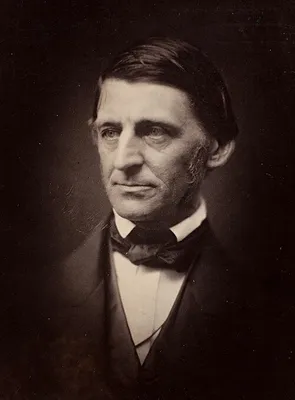
Ralph Waldo Emerson was a central figure of American Transcendentalism, championing individualism and the soul's connection to the universe.
Ralph Waldo Emerson (1803–1882) was a leading American essayist, lecturer, and philosopher who spearheaded the Transcendentalist movement. Initially a Unitarian minister, he diverged from traditional religious and social norms to formulate his own philosophical ideas. Emerson's thinking emphasized individualism, the boundless potential of humanity, and the profound relationship between the individual soul and the universal spirit, which he often termed 'Nature'. His writings, often derived from lectures, explored themes of self-reliance, freedom, and the interconnectedness of all things.
His intellectual journey was shaped by personal experiences, including family losses and travels abroad. A pivotal moment occurred during his European tour, particularly his observations at the Jardin des Plantes in Paris, which illuminated for him the underlying unity of existence. Emerson's work profoundly influenced subsequent generations of writers and thinkers, establishing him as a cornerstone of American Romanticism. He is also remembered for his mentorship of Henry David Thoreau.
Transcendentalism and Core Philosophy
Emerson is best known as the architect of American Transcendentalism, a philosophical movement that emerged in the mid-19th century. He articulated this philosophy most notably in his 1836 essay "Nature," which challenged conventional views by proposing that the universe is composed of "Nature and the Soul." This perspective suggests a pantheistic or pandeistic worldview, where the divine is not separate from the world but inherent within it. Emerson championed the idea of the "infinitude of the private man," emphasizing individual potential and the capacity for self-discovery. His work consistently explored themes of freedom, the inherent power within individuals, and the deep connection between the human spirit and the surrounding cosmos. He eschewed rigid doctrines, preferring to develop and express evolving ideas on these subjects.
Intellectual Development and Influences
Emerson's intellectual path was marked by significant personal experiences and encounters. His early life included the loss of his father and the profound influence of his aunt, Mary Moody Emerson. His education at Harvard provided a foundation, though he did not distinguish himself academically. His travels in Europe proved crucial; in Paris, his observation of the systematic classification of plants at the Jardin des Plantes sparked an insight into the interconnectedness of all things, steering him away from theology and toward a more holistic understanding of existence. He also met prominent European thinkers like John Stuart Mill, William Wordsworth, Samuel Taylor Coleridge, and Thomas Carlyle, the latter becoming a significant influence and correspondent. Emerson's encounter with slavery during his travels also left a lasting impression, highlighting the stark contrasts within society.
Literary Contributions and Legacy
Emerson's major essays were often first delivered as lectures before being revised for publication. His "Essays: First Series" (1841) and "Essays: Second Series" (1844), along with "Nature," form the bedrock of his philosophical contributions. These works include seminal pieces such as "Self-Reliance," "The Over-Soul," and "Experience." His 1837 speech, "The American Scholar," was hailed as a significant intellectual declaration. Emerson's writings are characterized by their focus on the individual's inner life, spiritual intuition, and the transformative power of nature. He is recognized as a central figure in the American Romantic movement, leaving an indelible mark on American literature and philosophy, and inspiring many subsequent writers and thinkers, including his friend and fellow Transcendentalist, Henry David Thoreau.
Key Ideas
- Transcendentalism: Belief in the inherent goodness of people and nature, and the importance of individual intuition over dogma.
- Individualism: Emphasis on self-reliance, personal freedom, and the infinite potential of the individual soul.
- The Over-Soul: A concept of a universal spirit or divine presence that connects all beings and nature.
- Nature as a spiritual manifestation: Viewing the natural world as a reflection of the divine and a source of spiritual insight.
Notable Quotes
“Philosophically considered, the universe is composed of Nature and the Soul.”
“In all my lectures, I have taught one doctrine, namely, the infinitude of the private man.”
“One ear therefore heard the glad tidings of great joy, whilst the other was regaled with 'Going, gentlemen, going!'”
“I have sometimes thought that, in thedecyd”
“This mode of commemorating Christ is not suitable to me. That is reason enough why I should abandon it.”
Books by Sarvepalli Radhakrishnan, Charles A. Moore, Charles Alexander Moore
2 free public domain books · Read online or download