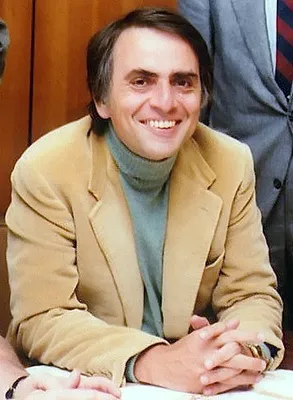
Samuel Sagan
Carl Sagan was an influential astronomer, science communicator, and author known for popularizing science and exploring humanity's place in the cosmos.
Carl Sagan was an American astronomer, planetary scientist, and dedicated science communicator who significantly impacted public understanding of space and science. He held a professorship at Cornell University and was deeply involved in major space missions like Mariner, Viking, and Voyager. Sagan authored numerous scientific papers and popular science books, with "The Dragons of Eden" earning him a Pulitzer Prize. His work extended into media, co-writing and narrating the acclaimed "Cosmos: A Personal Voyage" documentary series. He also explored themes of extraterrestrial life and the scientific method in his writings and public advocacy.
Sagan's early life was shaped by his parents, who instilled in him both skepticism and a sense of wonder, crucial elements he later identified as central to the scientific method. A pivotal experience was his visit to the 1939 New York World's Fair, which ignited his fascination with science and the vastness of the universe. His intellectual curiosity led him to explore astronomy from a young age, pursuing it as a passion and later a career. His early writings, including an essay on the potential dangers of extraterrestrial contact, demonstrated his thoughtful engagement with complex scientific and philosophical questions.
Cosmic Perspective and Science Communication
Carl Sagan was a prominent figure in astronomy and planetary science, renowned for his exceptional ability to communicate complex scientific ideas to the public. His work on missions such as Mariner, Viking, and Voyager, alongside his prolific writing, brought the wonders of the universe to millions. He authored many scientific papers and popular books, including "The Cosmic Connection" and the Pulitzer Prize-winning "The Dragons of Eden." Sagan co-created and narrated the influential "Cosmos: A Personal Voyage" series, which reached an enormous global audience and received significant accolades. His efforts aimed to foster a broader understanding of science and humanity's place within the vastness of space.
Skepticism, Wonder, and the Scientific Method
Sagan's approach to science was deeply rooted in a blend of skepticism and wonder, a combination he attributed to his parents and considered fundamental to the scientific method. He championed critical thinking and the rigorous application of evidence, famously stating, "Extraordinary claims require extraordinary evidence." His book "The Demon-Haunted World" explored these themes, advocating for a rational approach to understanding the world and debunking pseudoscience. He was instrumental in developing universal messages intended for potential extraterrestrial intelligence, such as the Pioneer plaques and the Voyager Golden Record, reflecting a lifelong interest in the possibility of life beyond Earth.
Early Influences and Intellectual Development
Born in New York City, Carl Sagan's early life was marked by his parents' influence, who fostered his analytical mind and sense of awe. His mother's unfulfilled intellectual ambitions and his father's compassionate nature provided a foundation for his dual appreciation of reason and wonder. A transformative experience was his visit to the 1939 New York World's Fair, which exposed him to futuristic visions and scientific marvels, sparking a lifelong fascination with the cosmos. His early education, including his bar mitzvah and high school years, revealed a prodigious intellect that often outpaced his formal schooling, leading him to pursue scientific knowledge independently.
Key Ideas
- Popularization of science and astronomy
- Advocacy for skepticism and the scientific method
- Exploration of extraterrestrial life
- Humanity's place in the universe
- Critical thinking toolkit
Notable Quotes
“Extraordinary claims require extraordinary evidence.”
Books by Samuel Sagan
2 free public domain books · Read online or download