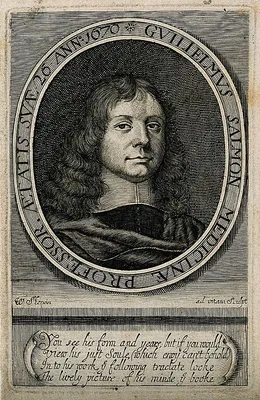
Salmon, William
William Salmon was an English empiric doctor and prolific medical writer known for practical texts and self-promoted medications.
William Salmon (1644–1713) was an English medical practitioner and author who operated as an empiric doctor, positioning himself as a "Professor of Physick." He held a contentious place within the medical establishment, leading apothecaries in their opposition to physicians' attempts to control medicine dispensing, which led to him being derided by some physicians as "the King of the Quacks." Salmon's writings focused heavily on practical application over theoretical considerations and often promoted his own medicinal products. He compiled his popular books by drawing from various sources, a practice common at the time. His works covered a broad spectrum of medical topics, and they were widely read, even being owned by notable figures like Isaac Newton and Daniel Defoe.
Little is documented about Salmon's early life or education, though he may have traveled. He established his practice in London near St. Bartholomew's Hospital, engaging in various common medical practices of the era, including compounding and selling prescriptions, casting horoscopes, and studying alchemy. Over his career, he moved several times within London. Salmon's approach to medicine emphasized "Medicina practica," or practical physick, recommending herbal remedies and demonstrating keen observation in his descriptions of conditions like senile dementia and depression. He developed and marketed proprietary medicines, including pills and elixirs, which were heavily advertised in his books.
Medical Practice and Public Perception
William Salmon carved out a unique position in the medical landscape of his time. He was an empiric doctor, meaning his practice was based on experience and observation rather than formal academic training, and he advertised himself as a "Professor of Physick." This stance often put him at odds with the established medical community, particularly physicians. Salmon became a leader among apothecaries in resisting efforts by physicians to gain exclusive control over the dispensing of medicines. This conflict resulted in him being disparagingly labeled "the King of the Quacks" by his detractors. Despite this criticism, he was also recognized for his public relations skills, described as a "brilliant publicist." His practice involved treating ailments, preparing and selling remedies, and engaging in practices like astrology and alchemy, which were integrated into the broader spectrum of medical care during that period.
Authorship and Literary Style
Salmon was an exceptionally prolific author, producing numerous texts on a wide array of subjects including medicine, surgery, pharmacology, alchemy, astrology, and even art. His prolific output was partly due to his method of compilation, drawing extensively from the works of others, which he openly acknowledged. He translated, abridged, and enlarged existing texts, often emphasizing practical techniques and knowledge. While this approach made his books popular and accessible, it also drew criticism for a lack of original contribution and insufficient citation. His writing style blended contemporary chemical and philosophical language with older medical terminology, a mix that some found effective for marketing, while others deemed it "absurd rhetoric." His works were intended to be practical guides, appealing to a broad audience seeking actionable information.
Esoteric and Philosophical Interests
While primarily known for his medical writings, Salmon's interests extended into areas that touch upon esoteric and philosophical pursuits. His engagement with alchemy suggests an interest in the transformation of matter and potentially spiritual enlightenment, common themes in early modern esoteric traditions. He also studied astrology and chiromancy, practices that involved interpreting celestial bodies and the lines of the hand to understand destiny and human character. Furthermore, Salmon's intellectual curiosity is evidenced by his extensive personal library, which contained scientific and mathematical instruments, indicating a mind open to diverse forms of knowledge. His writings on religious topics, such as baptism and transubstantiation, and his publication supporting the Quakers, reveal a broader engagement with theological and philosophical questions of his day.
Key Ideas
- Emphasis on practical medicine (Medicina practica) over theory.
- Compilation and adaptation of existing medical and scientific knowledge.
- Marketing of proprietary medicinal products.
- Challenging the authority of physicians and advocating for apothecaries' rights.
Notable Quotes
“Professor of Physick”
“the King of the Quacks”
“a brilliant publicist, but not much of a philosopher”
“copied, translated, abridged, enlarged and compiled from the texts of others”
“we have scrutinized the best Authors, to many of which we have been very much beholden”
Books by Salmon, William
0 free public domain books · Read online or download