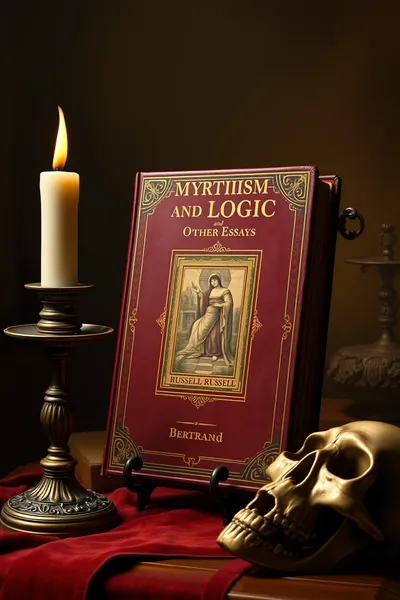
Russell, Bertrand
Bertrand Russell was a philosopher, logician, and mathematician who significantly influenced analytic philosophy and logic.
Bertrand Arthur William Russell, 3rd Earl Russell, was a prominent English philosopher, logician, and mathematician whose work profoundly shaped analytic philosophy and logic in the early 20th century. Alongside contemporaries like G. E. Moore and Ludwig Wittgenstein, Russell led a significant shift in philosophical thought, notably the British "revolt against idealism." His collaboration with Alfred North Whitehead on "Principia Mathematica" was a foundational text in classical logic and a major exploration of logicism, the idea that mathematics can be reduced to logic. Russell's intellectual contributions extended to set theory and his influential essay "On Denoting" is considered a paradigm of philosophical writing.
Beyond his academic achievements, Russell was also a vocal public intellectual and activist. He held pacifist views, championed anti-imperialism, and was imprisoned for his stance during World War I. His political and social views evolved over time, encompassing initial support for appeasement before condemning totalitarianism and advocating for nuclear disarmament. In recognition of his extensive writings promoting humanitarian ideals and freedom of thought, Russell was awarded the Nobel Prize in Literature in 1950, alongside numerous other academic honors.
Philosophical Foundations and Logicism
Bertrand Russell was a key figure in the development of analytic philosophy, working alongside G. E. Moore to challenge prevailing idealist philosophies. His intellectual journey led him to focus on the logical underpinnings of mathematics. Collaborating with Alfred North Whitehead, Russell co-authored "Principia Mathematica," a monumental work aimed at demonstrating that mathematics could be derived entirely from logic. This project, known as logicism, sought to establish a rigorous logical foundation for all mathematical truths. Russell's own philosophical contributions include his seminal 1905 essay "On Denoting," which is widely regarded as a landmark in philosophical analysis for its clarity and impact. His early academic work, such as "An Essay on the Foundations of Geometry," also explored the logical structures of mathematical concepts.
Early Life and Intellectual Awakening
Born into an aristocratic and liberal family, Bertrand Russell's early life was marked by significant loss, with the deaths of his mother and sister, followed by his father. He was raised by his paternal grandparents, whose influence shaped his early views. His grandmother, Countess Russell, despite her conservative religious views, fostered a sense of social justice in him. Russell's adolescence was characterized by loneliness and existential contemplation, from which his interest in mathematics and literature provided solace. He found profound inspiration in the works of Euclid and Percy Bysshe Shelley. By his late teens, Russell had critically examined religious dogma, eventually becoming an atheist and questioning concepts like free will and the afterlife, influenced by thinkers like John Stuart Mill.
Activism and Public Life
Russell's life extended far beyond academia; he was a committed public intellectual and activist. He was a staunch pacifist, advocating against imperialism and even serving a prison sentence for his anti-war activities during World War I. His views on international conflict evolved, leading him to see war as a regrettable necessity at times, but he later became a vocal critic of totalitarian regimes and the Vietnam War. In the post-World War II era, he expressed a preference for American global leadership over Soviet dominance and championed the cause of nuclear disarmament. His broad engagement with social and political issues, coupled with his significant philosophical and logical contributions, earned him widespread recognition, including the Nobel Prize in Literature.
Key Ideas
- Logicism: The philosophical position that mathematics is reducible to logic.
- Analytic Philosophy: A major philosophical tradition characterized by an emphasis on logic and language analysis.
- Revolt against Idealism: A philosophical movement challenging the dominance of idealism in British philosophy.
Notable Quotes
“I spent all my spare time reading him, and learning him by heart, knowing no one to whom I could speak of what I thought or felt, I used to reflect how wonderful it would have been to know Shelley, and to wonder whether I should meet any live human being with whom I should feel so much sympathy.”
“I found myself filled with semi-mystical feelings about beauty and with a desire almost as profound as that of the Buddha to find some philosophy which should make human life endurable. At the end of those five minutes, I had become a completely different person.”
Books by Russell, Bertrand
0 free public domain books · Read online or download