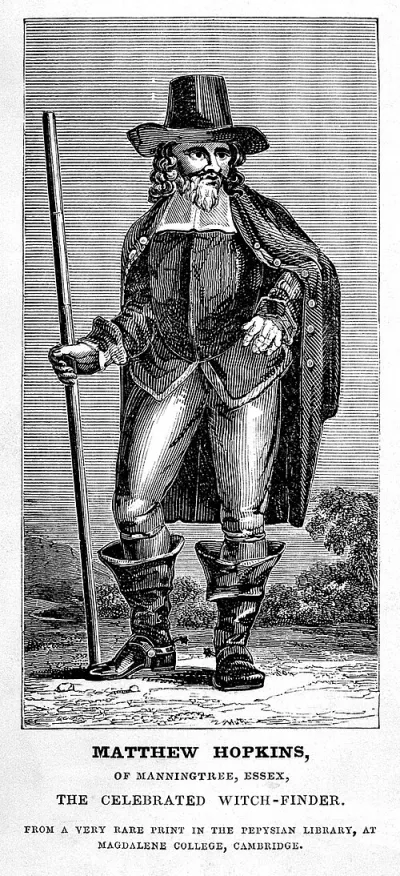
Matthew Hopkins was an English witch-hunter active during the Civil War, known for his controversial methods and significant impact on witch trials.
Matthew Hopkins, active primarily in East Anglia during the English Civil War, styled himself as the "Witchfinder General," though this title was not officially recognized. Born around 1620, the son of a Puritan minister, Hopkins began his career in March 1644 and continued until 1647. He and his associate, John Stearne, were responsible for a dramatic increase in witchcraft accusations and executions, surpassing the combined efforts of previous witch-hunters over a century and a half. Their activities significantly heightened the number of witch trials during their operational period.
Hopkins's methods were heavily influenced by King James I's "Daemonologie," which he cited in his own book, "The Discovery of Witches." Despite England's nominal prohibition of torture, Hopkins employed tactics such as sleep deprivation to coerce confessions. He also utilized methods like pricking the accused with a blunt knife to find a "Devil's mark" that wouldn't bleed, and the "swimming test," where suspects were thrown into water to see if they would float, indicating rejection by the element due to their pact with the Devil. These practices, while controversial and eventually leading to opposition and legal scrutiny, also had a notable impact on witch-hunting practices in the New England colonies.
Early Life and Influences
Details regarding Matthew Hopkins's life before 1644 are scarce, with no surviving contemporary documents about him or his family. He was born in Great Wenham, Suffolk, the fourth of six children to James Hopkins, a Puritan clergyman. The family held property in Framlingham. Hopkins's father died in 1634. Matthew himself moved to Manningtree, Essex, in the early 1640s. Tradition suggests he used an inheritance to establish himself as a gentleman and purchase the Thorn Inn in Mistley. While his presentation of evidence in trials has led some to believe he was trained as a lawyer, concrete evidence for this is limited. His religious background as the son of a Puritan minister likely shaped his worldview and approach to his later activities.
Witch-Hunting Career and Methods
Hopkins initiated his witch-hunting career in March 1644, reportedly after overhearing women discussing meetings with the Devil. Working alongside John Stearne, Hopkins claimed official sanction, traveling through East Anglia and other Parliamentarian strongholds. They charged towns fees for their services, often amounting to twenty shillings per town, plus expenses, leading to significant costs for local communities and even requiring special local taxes. Hopkins's methods, detailed in "The Discovery of Witches," drew inspiration from King James I's "Daemonologie." He employed sleep deprivation, the "swimming test" (though later warned against and legally abandoned), and the search for a "Devil's mark" by pricking suspects with knives or needles, believing such marks were insensitive to pain and would not bleed. These practices, aimed at extracting confessions, were controversial even at the time.
Opposition and Legacy
Hopkins's activities generated opposition, notably from John Gaule, vicar of Great Staughton, who published "Select Cases of Conscience touching Witches and Witchcrafts" (1646) and preached against witch-hunting. In Norfolk, both Hopkins and Stearne faced questioning from justices of the assizes regarding their methods and fees. By 1647, both men had retired. Hopkins's book, "The Discovery of Witches," published that year, outlined his practices and influenced witch trials in the New England colonies. The first execution for witchcraft in New England occurred in 1647, followed by a period of intense accusations and executions until 1663, with some cases explicitly employing Hopkins's techniques.
Key Ideas
- Witchcraft as heresy against Christianity, stemming from a pact with the Devil.
- The necessity of extracting confessions from accused witches due to the nature of their supposed pact.
- Use of specific investigative techniques, including sleep deprivation, the swimming test, and searching for the Devil's mark.
Books by
2 free public domain books · Read online or download