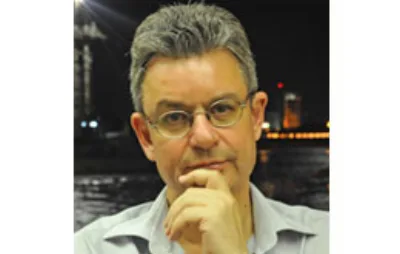
Shmuel "Sam" Vaknin is an Israeli writer and theorist known for his work on narcissism and his unique theories on time.
Shmuel "Sam" Vaknin, born in Israel in 1961, is an author and commentator recognized for his extensive writings on narcissistic personality disorder (NPD). He describes his own experiences with NPD, which he attributes to a traumatic childhood. After serving in the Israel Defense Forces, Vaknin pursued business ventures and academic study, including a doctorate exploring his theories on time asymmetry and the existence of a particle called a chronon. He faced legal consequences for securities fraud in the mid-1990s, leading to imprisonment. During his sentence, he began writing his seminal work on narcissism. Since his release, Vaknin has dedicated himself to educating the public about NPD through various online platforms and publications, significantly raising awareness of the condition. He has also held academic positions and advised governmental bodies.
Theories on Time and Chronons
Vaknin's academic pursuits included a doctoral dissertation on "Time Asymmetry Revisited," where he proposed a theoretical particle known as a 'chronon.' He posited that interactions involving this chronon within a 'Time Field' are responsible for the perception of time and its inherent asymmetry. This theoretical framework has been further developed by other researchers into the Geometric Chronon Field Theory. His work in this area represents a unique philosophical and theoretical exploration into the fundamental nature of time.
Narcissistic Personality Disorder (NPD) and the Self
A significant portion of Vaknin's work focuses on Narcissistic Personality Disorder (NPD), which he views as a complex post-traumatic stress condition. He distinguishes between a healthy form of narcissism, essential for self-esteem, and a malignant form stemming from abuse. Vaknin posits that individuals with NPD develop a 'false self'—characterized by delusions of grandeur—to mask a lost 'true self.' This false self is incapable of genuine empathy or love, requiring constant external validation, termed 'narcissistic supply,' to fill an internal void. He further categorizes narcissists into 'cerebral' (intellectual exhibitionists) and 'somatic' (physical appearance focused), identifying himself as cerebral. He also describes 'inverted narcissists' who are drawn to relationships with narcissists.
Psychological and Social Dynamics of Narcissism
Vaknin elaborates on the manipulative and charming tactics employed by individuals with NPD to secure narcissistic supply. He identifies two types of supply: primary, from everyday interactions, and secondary, derived from the appearance of success, often bolstered by family members. Children, in his view, are a primary source of supply, often instrumentalized to fulfill parental ambitions. Narcissists may also provoke negative emotions if positive attention is unavailable, lacking the capacity for genuine empathy, though they can exhibit 'cold empathy' by observing others' behaviors. Their emotional range is often limited to negative feelings, leading them to adopt victim or survivor identities. Instead of love or joy, they may experience a parasitic form of elation through merging with others.
Key Ideas
- Chronon: A theoretical particle posited to be responsible for the generation of time and time asymmetry.
- Malignant Narcissism: A severe form of narcissism resulting from trauma, characterized by a 'false self' and lack of empathy.
- Narcissistic Supply: The constant need for external validation and admiration required by individuals with NPD.
- Cold Empathy: The ability to intellectually recognize emotions in others without experiencing them.
Notable Quotes
“I had no idea what he was talking about. I tried to corrupt him, I offered him money, and having felt that I succeeded, I lost all interest in him.”
“I was borderline, schizoid, but the most dominant was NPD.”
“it was a relief to know what I had.”
“withdraw[s] inwards, to seek gratification from a secure, reliable and permanently available source: from one’s self’”
“false self”
Books by
2 free public domain books · Read online or download