Robin Lorsch Wildfang
Bona Dea, the 'Good Goddess,' was a Roman deity primarily venerated by women, associated with fertility, healing, and state protection.
Bona Dea, whose true name remains unknown, was a significant goddess in ancient Roman religion, primarily revered by women. Her epithets included 'The Good Goddess,' 'The Women's Goddess,' and 'The Holy One.' Roman literary sources suggest she was introduced from Magna Graecia and established with a state cult on the Aventine Hill. Her worship was characterized by rites that allowed women access to wine and blood sacrifice, practices otherwise restricted by Roman tradition. Men were largely excluded from her mysteries, and her true identity was a subject of much speculation among ancient authors, who linked her to various other goddesses such as Terra, Ops, Cybele, Ceres, and Demeter, or identified her as a female counterpart to the god Faunus.
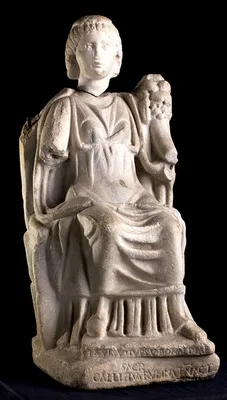
Two main annual festivals honored Bona Dea. One took place at her Aventine temple, benefiting the Roman populace. The second, a more exclusive event hosted by the wife of a senior magistrate for elite women, gained notoriety in 62 BC due to a scandal involving a man's alleged intrusion. Surviving imagery depicts her as a dignified Roman matron, often accompanied by a cornucopia and a snake. Her cult attracted dedications from various social strata, including men who served as her acolytes and priests, indicating a broader, though still restricted, engagement with her worship.
Identity and Origins
The identity of Bona Dea, Latin for 'Good Goddess,' was shrouded in mystery, with her true name being deliberately concealed. She was known by several respectful pseudonyms, including 'The Women's Goddess' and 'The Holy One.' Roman historians speculated about her origins and nature, proposing she might be an aspect of other deities like Terra, Ops, Cybele, or Ceres, or a Latinized version of the Greek goddess Damia, possibly related to Demeter. Some sources identified her as the wife, sister, or daughter of the pastoral god Faunus, thus linking her to Fauna, a goddess associated with fertility and prophecy. These varied attributions highlight her multifaceted nature and the limited understanding male authors had of her rites.
Mythology and Symbolism
While prominent authors like Cicero made no mention of myths surrounding Bona Dea, later scholars developed narratives connecting her to the goddess Fauna. These myths often depicted Fauna as the daughter, wife, or sister of Faunus, a prophetic figure. One prominent myth, recounted by Macrobius, describes Bona Dea as Faunus' daughter who resisted his incestuous advances, leading him to transform into a serpent to have intercourse with her. This story, bearing resemblances to Greek myths, potentially explains the serpent imagery associated with her rites and the goddess's association with chthonic themes. The exclusion of men from her cult was often explained by her extreme modesty, with the myth serving to reinforce her image as a paragon of female virtue.
Festivals and Rituals
Bona Dea's cult featured two primary annual festivals. The Aventine temple festival, held on May 1, was likely a more public affair, possibly with plebeian associations, and its origins are sometimes credited to Claudia Quinta. A second, more exclusive festival occurred in December in the home of a senior magistrate, hosted by his wife for elite women. This nocturnal ritual involved the symbolic cleansing of the space from unauthorized males, the decoration of the hall, and the ritual placement of Bona Dea's cult image. The rites included feasting, music, and the consumption of wine, euphemistically called 'milk.' These ceremonies allowed women a temporary release from societal constraints, focusing on female sexuality and potency in a ritually sanctioned context. The sacrifices often involved a sow, and elements like wine, myrtle, and serpents were significant, echoing practices associated with other fertility goddesses.
Key Ideas
- Association with chastity and fertility among married women
- Goddess of healing and protection of the state
- Rites involving wine and blood sacrifice for women
- Exclusion of men from certain mysteries
- Speculative identities and origins
- Dual festivals: Aventine temple and magistrate's home
- Symbolism of serpents and cornucopia in imagery
Books by Robin Lorsch Wildfang
2 free public domain books · Read online or download