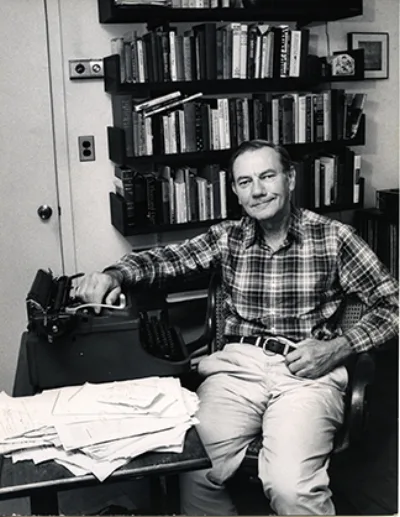
Daniel Lang was a New Yorker staff writer known for his morally weighty journalism on war, atomic testing, and individual complicity in evil.
Daniel Lang was an American author and journalist who served as a staff writer for The New Yorker from 1941 until his death in 1981. Born in New York City to Hungarian Jewish immigrants, Lang's early life experiences on the Lower East Side were later reflected in his semi-autobiographical writing. He pursued higher education at the University of Wisconsin before embarking on a career in journalism, working for The New York Post and later The New Yorker.
Throughout his extensive career, Lang covered significant global events, including World War II as a war correspondent in Europe and North Africa, and the moral implications of atomic testing. He also delved into the ethical complexities of the Vietnam War, notably exposing atrocities against civilians. His later work examined how individuals become involved in historical atrocities, such as through the experiences of aging Germans during the Third Reich. Lang's writings, often collected into books, were recognized for their moral depth and directness in exploring the human conscience and its engagement with societal challenges.
Journalistic Focus and Moral Inquiry
Daniel Lang's journalistic career, primarily with The New Yorker, was characterized by a deep engagement with significant moral and ethical questions arising from major historical events. He meticulously reported on the aftermath of atomic testing, focusing on the responsibilities of scientists and the broader societal implications of nuclear proliferation. During the Vietnam War era, Lang was among the first reporters to bring attention to military misconduct and atrocities against civilian populations, highlighting the difficult ethical choices faced during conflict. His work consistently explored how individuals become implicated in acts of evil, often through mechanisms of denial or a refusal to confront reality. This was particularly evident in his later interviews with former Flakhelfer, exploring their roles within the Third Reich.
The Conscience and Human Complicity
Former editors and colleagues described Lang's writing as possessing significant moral weight and a focus on the human conscience. He was committed to understanding the people he wrote about, striving to convey their experiences without resorting to abstraction, even when dealing with profound themes. His approach involved presenting stories of individuals confronting major historical and societal challenges, allowing the directness of their experiences to resonate with readers. This method underscored his belief that a writer's role was to address the moral dimensions of society, examining how ordinary individuals navigate complex ethical landscapes and the consequences of their choices.
Broader Literary Contributions
Beyond his extensive magazine reporting, Daniel Lang's creative output extended to various literary forms. He authored poetry, children's literature, and short stories, demonstrating a versatility in his writing. Notably, he also contributed to the operatic form by writing an opera libretto. His New Yorker article, 'The Bank Drama,' which detailed a hostage situation in Stockholm, gained significant recognition as it provided the context for psychiatrist Nils Bejerot to coin the term 'Stockholm syndrome,' illustrating the far-reaching impact of his journalistic observations.
Key Ideas
- Moral responsibility in the face of technological advancement (e.g., atomic testing)
- Individual complicity in historical atrocities
- The role of denial and refusal to acknowledge reality in perpetuating evil
- Ethical choices and consequences during times of conflict
- The exploration of the human conscience through direct reporting
Notable Quotes
“He was one of the most steadfast and talented of our reportorial writers. His writings invariably had moral weight. He was a student of the conscience. Implicit in every piece he wrote was a controlling idea, but he never lapsed into abstraction. He tried very hard to understand the people he wrote about, and far more often than not he succeeded.”
“He arrived in our offices one day in 1941, shortly before the United States entered the Second World War, with an impressive sheaf of clippings of articles he had written for the New York Post. He was immediately taken onto the staff and soon wrote his first Reporter-at-Large piece on the British American Ambulance Corps.”
Books by
3 free public domain books · Read online or download