Rhonda Stapleton
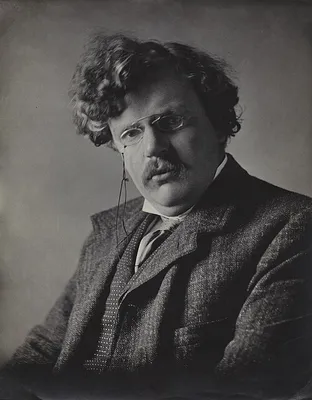
G.K. Chesterton was a prolific English writer, Christian apologist, and influential literary figure known for his wit and paradoxical style.
Gilbert Keith Chesterton (1874-1936) was a prominent English writer, theologian, and literary critic, celebrated for his sharp wit, paradoxical approach, and staunch defense of tradition. He profoundly impacted early 20th-century literature, creating the beloved fictional character Father Brown, a priest-detective. Chesterton's intellectual journey led him from a youth fascinated by the occult and agnosticism to a devout Christian, eventually converting to Catholicism. His work often explored themes of faith, reason, and morality, making him a significant voice in Christian apologetics. He engaged in public debates with prominent intellectuals of his time and was recognized for his distinctive writing style, which employed allegories and proverbs in unique ways. Chesterton's influence extended to other writers, including Jorge Luis Borges, and he was nominated for the Nobel Prize in Literature.
Born in London, Chesterton's early life included an interest in art and a period of experimentation with spiritualism alongside his brother. He received his education at St. Paul's School and briefly attended the Slade School of Art and University College London, though he did not complete degrees. His marriage to Frances Blogg was a significant influence, guiding him back to Anglicanism before his eventual Catholic conversion. Chesterton's extensive career included journalism, writing numerous books, essays, poems, and plays. He was a towering figure in London's literary circles and was posthumously honored and proposed for beatification by the Catholic Church.
Early Life and Occult Interests
Gilbert Keith Chesterton was born in London in 1874. Though baptized into the Church of England, his family were irregular Unitarian practitioners. In his youth, Chesterton explored the occult, experimenting with Ouija boards with his brother Cecil. He described himself as a pagan at age twelve and an agnostic by sixteen. His formal education included St. Paul's School and studies at the Slade School of Art and University College London, though he did not earn degrees. His marriage to Frances Blogg played a crucial role in his spiritual development, leading him back toward Anglicanism before his eventual full communion with the Catholic Church in 1922. This period of spiritual searching and experimentation highlights an early engagement with non-traditional beliefs before his embrace of orthodox Christianity.
Literary Style and Philosophical Defense
Chesterton is renowned for his distinctive literary style, often described as paradoxical and witty. He masterfully used proverbs, allegories, and popular sayings, frequently inverting them to make his points, earning him the moniker "the prince of paradox." His writing served as a powerful defense of tradition and orthodox Christian beliefs. Works like "Orthodoxy" and "The Everlasting Man" exemplify his apologetic efforts. He possessed a unique ability to imbue abstract concepts with vivid, concrete imagery, a trait evident in his creation of the priest-detective Father Brown, whose stories often involve moral and spiritual resolution. His intellectual contributions positioned him as a successor to significant Victorian thinkers.
Career and Public Influence
Chesterton's career spanned journalism, fiction, and essay writing, resulting in a vast body of work including around 80 books, hundreds of poems, and thousands of essays. He held influential columns for publications like The Daily News and The Illustrated London News for decades. A charismatic debater, he frequently engaged in public discussions with contemporaries such as George Bernard Shaw and H. G. Wells. His physical presence was notable, and he often appeared in public with a cape and hat. Chesterton also participated in the Detection Club, a society of mystery writers, serving as its first president. His popular radio talks for the BBC in the early 1930s further extended his reach, with a BBC official noting he was becoming a dominant broadcasting voice.
Key Ideas
- Christian apologetics
- Defense of tradition
- Paradoxical literary style
- Moral and spiritual themes
- Distributism
Notable Quotes
“If you go round to the side, you will see that I am.”
“To look at you, anyone would think a famine had struck England.”
“There is still youth and honour and humour in you; don't fancy they will last in that trade. Men may keep a sort of level of good, but no man has ever been able to keep on one level of evil. That road goes down and down. The kind man drinks and turns cruel; the frank man kills and lies about it. Many a man I've known started like you to be an honest outlaw, a merry robber of the rich, and ended stamped into slime.”
Books by Rhonda Stapleton
2 free public domain books · Read online or download