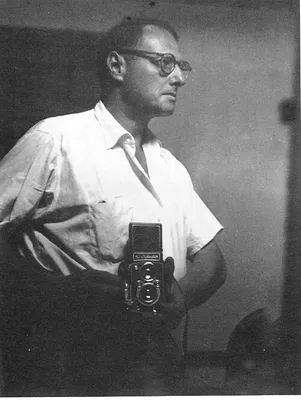
Pierre Verger
Pierre Verger was a globetrotting photographer turned ethnographer dedicated to documenting the African diaspora and its religious traditions.
Pierre Verger, born in Paris in 1902 and passing in Salvador, Brazil in 1996, was a multifaceted figure known for his work as a photographer, self-taught ethnographer, and eventually, a Yoruba priest. After a career as a photojournalist spanning 15 years and multiple continents, Verger settled in Salvador, Brazil. There, his interest shifted to the study of the African diaspora, focusing on the slave trade and the preservation of African-based religions and their cultural impact in the Americas.
His dedication led him to become an initiate of Candomblé and to be ordained as a babalawo, a priest of Ifá, in Benin, adopting the name Fátúmbí. Verger's extensive research, documented through numerous publications and a significant photographic archive, earned him recognition, including a doctorate from Sorbonne University. He also contributed academically as a professor and was instrumental in establishing the Afro-Brazilian Museum in Salvador.
A Photographer's Global Journey
Initially pursuing a career in journalistic photography at the age of 30, Pierre Verger embarked on extensive travels across four continents. Over roughly 15 years, he meticulously documented diverse civilizations, capturing images of cultures that were on the cusp of profound change due to modernization. His photographic expeditions took him to locations as varied as Tahiti, the United States, Japan, China, various African nations including Sudan and Dahomey, the West Indies, Mexico, the Philippines, Indochina, Guatemala, Ecuador, Senegal, Argentina, Peru, Bolivia, and finally Brazil in 1946. His work gained visibility through publications like Paris-Soir and Life, and was even featured in the influential 'The Family of Man' exhibition at MoMA.
Ethnographic Focus on the African Diaspora
Upon settling in Salvador, Brazil, Verger's professional path evolved significantly. Deeply captivated by the local culture and history, he transitioned from a traveling photographer to a dedicated researcher of the African diaspora. His subsequent travels were specifically targeted towards understanding the enduring influences of African cultures, particularly the Yoruba people, in the Americas. This focused research included journeys to the west coast of Africa, Paramaribo, Haiti, and Cuba, aiming to trace the cultural and religious connections stemming from the transatlantic slave trade.
Spiritual Initiation and Scholarly Recognition
Verger's immersion in the study of African traditions led him to embrace the Candomblé religion, becoming an initiate and participating in its rituals. His spiritual journey culminated in Benin, where he was initiated into the Ifá divination system and became a babalawo, a Yoruba priest, receiving the name Fátúmbí, signifying rebirth through the Ifá oracle. This profound engagement with Yoruba spirituality informed his ethnographic work. His scholarly contributions were later acknowledged by Sorbonne University, which awarded him a doctorate, despite his earlier departure from high school.
Legacy and Archival Preservation
Continuing his dedication until his passing at 93, Verger held academic positions, including professorships at the Federal University of Bahia and the University of Ifé in Nigeria. He played a key role in establishing the Afro-Brazilian Museum in Salvador. To ensure the continuation of his life's work, he founded the Pierre Verger Foundation in Salvador. This foundation safeguards an extensive archive of over 63,000 photographs and negatives taken up to 1973, alongside his research papers and correspondence, preserving a vital record of the African diaspora.
Key Ideas
- The study and documentation of the African diaspora
- The impact of the slave trade on cultural and religious flows
- The preservation and understanding of African-based religions in the New World
- The connection between Yoruba traditions and Candomblé
- The role of photography in ethnographic research
Books by Pierre Verger
2 free public domain books · Read online or download