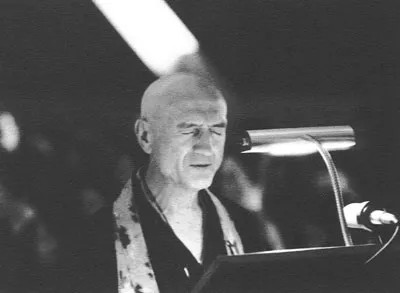
Philip Kapleau
Philip Kapleau was an American Zen Buddhist teacher who founded the influential Rochester Zen Center.
Philip Kapleau (1912-2004) was a significant figure in bringing Zen Buddhism to the West. Initially working as a court reporter, including for the Nuremberg and Tokyo war crimes trials, his experiences in Japan sparked an interest in Zen. Dissatisfied with a purely academic understanding, he moved to Japan in 1953 to pursue deeper training.
He underwent rigorous training in the Harada-Yasutani tradition, a blend of Sōtō and Rinzai methods, and was ordained in 1965. Kapleau established the Rochester Zen Center in 1966, which became a major hub for Zen practice in North America and inspired numerous affiliate centers globally. His teaching emphasized that Zen's core principles were accessible to all, not just monastics, and adapted readily to new cultural contexts. He also advocated for Buddhist vegetarianism. Kapleau's influential book, 'The Three Pillars of Zen,' remains a foundational text in English for understanding Zen practice.
Early Life and Introduction to Zen
Born in New Haven, Connecticut, Philip Kapleau's early career involved bookkeeping and court reporting. He notably served as the chief Allied court reporter for the Nuremberg Trials and later covered the Tokyo War Crimes Trials. During his time in Japan for the latter, he encountered Zen Buddhism. An introduction to D.T. Suzuki's lectures led him to seek more profound understanding, prompting his move to Japan in 1953 to immerse himself in Zen practice, moving beyond intellectual study.
Zen Training and Lineage
Kapleau undertook extensive training in Japan under prominent teachers such as Soen Nakagawa and Daiun Harada, and later Hakuun Yasutani, a student of Harada. His practice was rooted in the Harada-Yasutani tradition, which combined elements of the Sōtō and Rinzai schools, including koan study. After thirteen years of dedicated training, he received ordination from Yasutani in 1965, signifying his authorization to teach. While Kapleau was given permission to teach and completed a significant portion of the Harada-Yasutani koan curriculum, the formal dharma transmission was a point of complexity, leading him to establish his own independent lineage.
Founding the Rochester Zen Center and 'The Three Pillars of Zen'
Following his return from Japan, Kapleau founded the Rochester Zen Center in 1966 after an invitation to teach meditation. This center grew into one of the most influential Zen communities in the West, with affiliate centers spreading across North America, Europe, and beyond. His seminal work, 'The Three Pillars of Zen,' published in 1965, became a landmark text. It demystified Zen practice for Western audiences, presenting it as a practical path for transformation rather than mere philosophy. The book's enduring popularity is evidenced by its translation into multiple languages and continued availability.
Teaching Philosophy and Later Life
Kapleau's teaching emphasized the accessibility of Zen insight for everyone and advocated for adapting its practices to local cultures, sometimes introducing modifications like chanting in vernacular languages. He cautioned against discarding essential elements while adapting forms. He also became a vocal proponent of Buddhist vegetarianism, arguing for it based on the principle of non-harmfulness. Kapleau continued to teach and guide students for nearly four decades, shaping Zen's presence in the West. He passed away peacefully in 2004 at the Rochester Zen Center, surrounded by his students and friends, leaving behind a substantial legacy and numerous authorized dharma heirs.
Key Ideas
- Zen Buddhism as a pragmatic path accessible to all.
- Adaptation of Zen practices to Western cultural contexts.
- The importance of non-harmfulness, including Buddhist vegetarianism.
- Using life's difficulties as 'grist for the mill' for personal growth.
Notable Quotes
“grist for the mill”
Books by Philip Kapleau
3 free public domain books · Read online or download