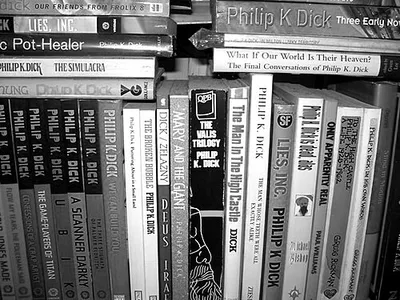
Philip K. Dick
Philip K. Dick was a prolific science fiction author whose work explored complex philosophical themes and has been widely adapted.
Philip K. Dick (1928–1982) was an American author known for his extensive body of work in science fiction, comprising 45 novels and 121 short stories published during his lifetime, alongside 14 short story collections. While his work was primarily known within science fiction circles at the time of his death, it has since gained broader recognition, with his novels translated into 25 languages. The Library of America has published several collections of his novels, notably including works that marked the first inclusion of science fiction in their canon. Dick's stories have also inspired numerous film adaptations, beginning with "Blade Runner" in 1982. His writing is characterized by recurring philosophical explorations of themes such as false realities, the distinction between humans and machines, entropy, the nature of divinity, and societal control.
Recurring Philosophical Themes
Philip K. Dick's literary output is frequently analyzed through the lens of several recurring philosophical themes. Scholars have identified concepts such as the nature of simulated or false realities, the complex boundary between human and artificial intelligence, the inevitable decay and disorder represented by entropy, inquiries into the divine and the nature of God, and the mechanisms of social control as central to his narratives. These themes highlight Dick's deep engagement with existential questions and the nature of perception, often blurring the lines between what is real and what is perceived.
Literary Output and Recognition
Throughout his career, Dick produced a substantial volume of work, including 45 novels and 121 short stories, alongside numerous collections. His literary legacy has been solidified by significant posthumous recognition, including multiple omnibus editions published by the Library of America, which have introduced his work to a wider audience and acknowledged science fiction's place within established literary canons. The extensive translation of his works into 25 languages further attests to their global appeal and enduring relevance. His correspondence, spanning from 1938 to 1982, has also been compiled and published, offering insights into his creative process and personal life.
Adaptations and Influence
The imaginative scope of Philip K. Dick's stories has led to numerous adaptations into film, beginning with the iconic "Blade Runner" in 1982. This cinematic engagement with his work has introduced his unique visions of the future and explorations of consciousness to mainstream audiences. Beyond film, his thematic concerns and narrative structures have profoundly influenced subsequent science fiction literature and speculative fiction, cementing his status as a pivotal figure in the genre. The ongoing interest in his bibliography, including comprehensive collections and scholarly analysis, underscores his lasting impact on literature and popular culture.
Key Ideas
- False realities
- Human vs. machine
- Entropy
- The nature of God
- Social control
- Epistemology and the Nature of Reality
- Know Thyself
- The Android and the Human
- The Theodicy Problem
- Warfare and Power Politics
- The Evolved Human
- Technology, Media, Drugs and Madness
Books by Philip K. Dick
0 free public domain books · Read online or download