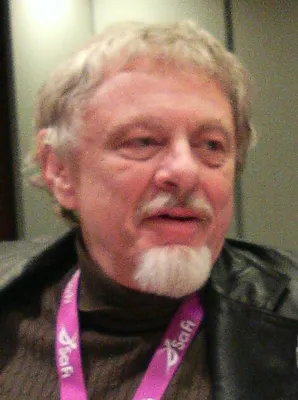
Norman Spinrad
Norman Spinrad is an award-winning American science fiction author known for exploring themes of power, sex, and societal structures, often with controversial content.
Norman Spinrad, born in 1940, is an American author celebrated for his contributions to science fiction, essays, and criticism. His career has been marked by critical acclaim, including the Prix Apollo award and multiple nominations for prestigious honors like the Hugo and Nebula Awards. Spinrad's educational background includes a degree from the Bronx High School of Science and City College of New York. He has lived in various major cities and was married to fellow novelist N. Lee Wood. Beyond his writing, Spinrad has held leadership positions, serving as President of the Science Fiction and Fantasy Writers of America (SFWA) for two terms. His professional life has also included roles as a radio host, vocal artist, and literary agent. Spinrad has identified himself publicly as an anarchist and syndicalist. His work frequently delves into complex societal issues, with some critics noting utopian elements, while others highlight his exploration of sex and power as primary themes. He has also spoken about the underappreciated influence of consciousness-altering substances on 20th-century American literature.
Literary Style and Themes
Spinrad's literary output is characterized by a refusal to adhere to artistic repetition, with each book offering unique explorations of thought and speculation. Critics often point to his engagement with themes of sex and power as central to his narratives. He has also expressed a belief in the potential for science fiction to explore better, more just societies, lamenting the current cultural climate's perceived lack of optimism about the future. Spinrad has openly discussed the significant, yet often overlooked, influence of psychedelic drugs and cannabis on American literary creation in the latter half of the 20th century, noting how this impact on form, style, and content has been largely unacknowledged in critical and biographical accounts, partly due to the illegal nature of these substances at the time.
Controversial Works and Reception
Several of Spinrad's works have generated significant controversy. His novel "Bug Jack Barron" faced difficulties in finding a book publisher, leading to its serialization in the magazine New Worlds. This publication led to a refusal of distribution by WHSmith and subsequent parliamentary debate in Great Britain. His 2007 novel, "Osama the Gun," also encountered resistance from American publishers, with one reportedly deeming it unpublishable. Spinrad ultimately chose to self-publish this work as an e-book, though it was later translated and published in French. "The Iron Dream," an alternate history novel that includes a fictional work attributed to Adolf Hitler, faced a ban in Germany for twenty-five years and was indexed by a federal department for being harmful to young persons, restricting its public display despite a lack of swastikas on its initial German cover.
Notable Works and Concepts
Spinrad's debut novel, "The Solarians" (1966), presented a more conventional space opera narrative. In contrast, "Bug Jack Barron" (1969) is recognized as a precursor to cyberpunk, exploring themes of immortality and conspiracy. "The Iron Dream" (1972) uses an alternate history framework to examine the nature of fascism and artistic influence. "A World Between" (1979) depicts a utopian society on the planet Pacifica, highlighting its ability to resolve conflicts through its superior social structure. Later works like "The Void Captain's Tale" (1983) and "Child of Fortune" (1985) delve into futuristic settings, exploring themes of self-discovery, societal roles, and blending elements of romance and adventure. His historical novel "The Druid King" (2003) focuses on the conflict between Vercingetorix and the Roman Empire.
Key Ideas
- Exploration of sex and power as primary themes in fiction.
- Critique of societal optimism and the perceived decline in belief in a better future.
- The significant, yet under-acknowledged, influence of consciousness-altering drugs on 20th-century literature.
- The potential for science fiction to depict morally superior and more just societies.
Notable Quotes
“How much science fiction is being published now that's set in worlds that are better than ours? Not that have bigger shopping malls or faster space ships, but where the characters are morally superior, where the society works better, is more just? Not many. It becomes difficult to do it, and that's a feedback relationship with what's happening in the culture, with science fiction being the minor note. People don't credit it anymore! Not just better gizmos and more virtual reality gear, but better societies. People don't believe the future will be a better place. And that is very scary.”
“If there's one gaping void in the story of American literary history in the second half of the twentieth century as currently promulgated, it's the influence of grass and psychedelic drugs, not only on the lives of writers, but on the content of what's been written, and on the form and style too. It's hard to be critically or biographically courageous when so much creative work was done under the influences of jailable offenses.”
Books by Norman Spinrad
2 free public domain books · Read online or download