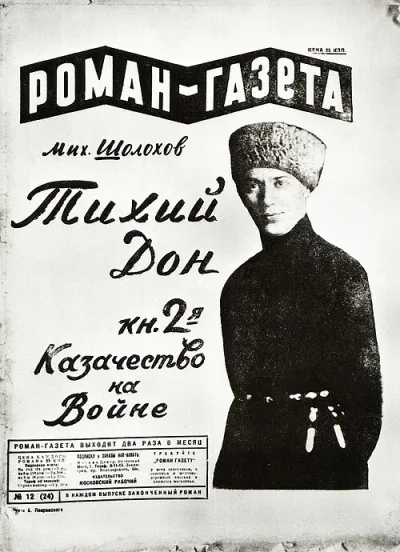
Mikhail Sholokhov's epic novel chronicles Cossack life through WWI and the Russian Revolution, earning him the Nobel Prize.
Mikhail Sholokhov penned the monumental four-volume novel "And Quiet Flows the Don" between 1925 and 1940. The work chronicles the tumultuous lives of the Don Cossacks, beginning around 1912 and spanning World War I, the Russian Revolution, and the subsequent Civil War. Its narrative centers on the Melekhov family, descendants of a Cossack who married a Turkish captive accused of witchcraft, leading to their family being nicknamed "Turks" and marked by a unique lineage. The story prominently features Grigory Panteleevich Melekhov, a soldier whose personal life, including a passionate but complicated romance, is interwoven with the sweeping historical events and conflicts that engulf the region and its people.
The novel has been recognized as a major literary achievement of the 20th century, with Sholokhov receiving the Nobel Prize in Literature in 1965 for his work. "And Quiet Flows the Don" is noted for its vivid depiction of Cossack culture, its exploration of the human cost of war and revolution, and its rich portrayal of the Don landscape, often enhanced by references to folk songs. Despite its acclaim, the novel has faced accusations of plagiarism, though investigations, including computational stylistic analyses, have largely supported Sholokhov's authorship.
Historical and Familial Context
The narrative of "And Quiet Flows the Don" begins by immersing the reader in the lives of the Don Cossacks just before World War I, around 1912. The story's roots are traced back to a historical event where a Cossack took a Turkish captive as a wife, an act that led to accusations of witchcraft from superstitious neighbors and resulted in the family being known as "Turks." This ancestral background influences the Melekhov family, who, despite this origin, hold a respected position within their community. The novel's scope expands to encompass the dramatic events of the First World War, the Russian Revolution, and the ensuing Civil War, highlighting the profound impact these conflicts had on the Cossack people and their way of life. The protagonist, Grigory Melekhov, is said to be inspired by real Cossacks involved in the anti-Bolshevik struggles.
Literary Significance and Reception
Considered a landmark of 20th-century literature, "And Quiet Flows the Don" has been compared to Leo Tolstoy's "War and Peace" for its epic scope and examination of Russian life during a period of immense upheaval. The novel delves into political, military, romantic, and civilian perspectives, offering a multifaceted portrayal of the era. Sholokhov was awarded the Nobel Prize in Literature in 1965, acknowledging the work's profound impact. However, the novel's authorship has been a subject of controversy, with accusations of plagiarism arising from claims that Sholokhov appropriated material from Fyodor Kryukov. Investigations, including modern computational methods, have generally affirmed Sholokhov's authorship, concluding that the text aligns with his known writing style and differs significantly from Kryukov's work. The survival and eventual rediscovery of the manuscript, partially in Sholokhov's handwriting, further supports its authenticity.
Thematic Depth and Cultural Elements
Beyond its historical and political narrative, "And Quiet Flows the Don" offers a deep exploration of human struggle, resilience, and the complexities of love and loyalty amidst chaos. The personal story of Grigory Melekhov, his relationships, and his shifting allegiances during the Civil War form a central thread. The novel is also celebrated for its vivid portrayal of the Don landscape, bringing the natural environment to life alongside the human drama. Furthermore, the text is enriched by numerous references to Cossack folk songs, embedding the narrative within a strong cultural tradition and adding layers of emotional and historical resonance. These songs and the depiction of folk traditions contribute significantly to the novel's authentic atmosphere and its status as a cultural touchstone.
Key Ideas
- Epic portrayal of Cossack life during historical upheaval
- Exploration of personal and political conflicts
- Depiction of love, loyalty, and resilience amidst war
- Rich integration of folk traditions and landscape
Notable Quotes
“The novel is considered one of the most significant works of literature in the 20th century.”
“It depicts the lives and struggles of Don Cossacks during the First World War, the Russian Revolution, and Russian Civil War.”
“In 1965, Sholokhov was awarded the Nobel Prize in Literature for the novel.”
“The novel deals with the life of the Cossacks living in the Don River valley during the early 20th century, starting around 1912, just prior to World War I.”
“The novel has been compared to Tolstoy's War and Peace (1869), notably by Maxim Gorky.”
Books by
3 free public domain books · Read online or download