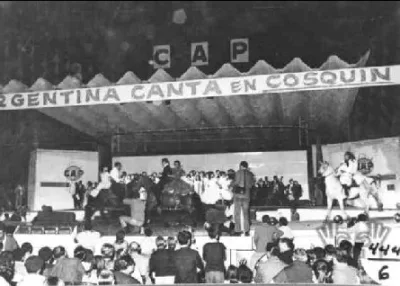
Argentine folkloric music is a rich tapestry woven from indigenous, European, and African threads, evolving through historical events and regional influences.
Argentine folkloric music is a complex cultural expression shaped by the nation's diverse history, including indigenous heritage, Spanish colonization, African slavery, and European immigration. While strictly defined as anonymous and traditional, in Argentina, 'folklore' often refers to popular music with known authorship, drawing inspiration from provincial rhythms rooted in indigenous and Afro-Hispanic traditions. This genre gained significant popularity in the mid-20th century, becoming a major national musical style alongside tango.
The music's evolution is often categorized into four main regional styles: Cordoba-Northwest, Cuyo, Littoral, and Pampa-Patagonian. Each region reflects distinct indigenous influences, such as the wind instruments and pentatonic scales of the Central-Andean cultures, the Guaraní contributions in the Littoral, the sacred a cappella singing of the Pampa-Patagonian peoples, and the interaction with nature in Chaco music. African roots, particularly Candombe, also form a crucial element of this musical landscape. The genre has undergone periods of expansion and adaptation, influenced by pan-Latin American movements and adapting to new expressions after periods of cultural repression.
Indigenous Musical Heritage
The indigenous peoples of Argentina contributed significantly to its folkloric music, with distinct traditions in four major areas: Central-Andean, Mesopotamian-Littoral, Chaco, and Pampa-Patagonian. The Central-Andean cultures, known for their sedentary agro-ceramic civilizations, heavily influenced Argentine 'Andean' folklore with wind instruments like the siku and quena, often based on pentatonic scales. Musical styles such as the baguala, yaraví, and huayno have pre-Hispanic origins. The Littoral area saw the development of a distinct musical culture within the Jesuit missions, influenced by the Guaraní. In the Pampa-Patagonian region, indigenous music, particularly from the Mapuche culture, retained its distinctiveness, characterized by sacred a cappella singing and unique instruments like the cultrun. The Chaco region's music often emphasizes interaction with natural sounds, simulating bird songs with instruments like the naseré and sereré.
African and European Contributions
The forced immigration of Africans during the colonial period introduced crucial elements to Argentine music, with Candombe being a significant folkloric contribution. Later, the large waves of European immigration between 1880 and 1950 also left an indelible mark, enriching the musical landscape with new styles and instruments. These diverse influences, alongside the internal migration from rural areas to cities, propelled folkloric music to prominence in the mid-20th century. It established itself as a primary national genre, sharing the spotlight with tango and expanding its reach through musical and lyrical renovations in the 1960s and 70s.
Regional Evolution and Mystical Echoes
Argentine folkloric music is broadly divided into four regions: Cordoba-Northwest, Cuyo, Littoral, and Pampa-Patagonian, each with unique characteristics and influences from neighboring countries. The Central-Andean region, for instance, features 'singing with caja,' a practice described as an ancient technique with powerful melodies and a connection to 'terrestrial and sidereal' dimensions, involving three notes and vocalizations akin to a 'cry in the sky' and 'lament.' The Pampa-Patagonian area's indigenous music, particularly Mapuche traditions, carries a strong sacred component. The Chaco region's instruments, like the nobique, are linked to musical legends, such as the origin of the Morning Star. These regional expressions reveal deeper connections to ancestral practices and the natural world.
Key Ideas
- Argentine folklore music is defined by its popular authorship, inspired by provincial indigenous and Afro-Hispanic roots.
- The music evolved through four major historical-cultural events: Spanish colonization, African immigration, European immigration, and internal migration.
- Four primary regional styles exist: Cordoba-Northwest, Cuyo, Littoral, and Pampa-Patagonian.
- Indigenous music contributed significant instrumental and stylistic elements, particularly wind instruments and pentatonic scales in the Andes, sacred singing in the Pampa-Patagonia, and nature-inspired sounds in the Chaco.
- African contributions, especially Candombe, are integral to the genre.
- The 'folklore boom' in the 1950s established it as a major national music genre alongside tango.
Books by
3 free public domain books · Read online or download