Melita Denning
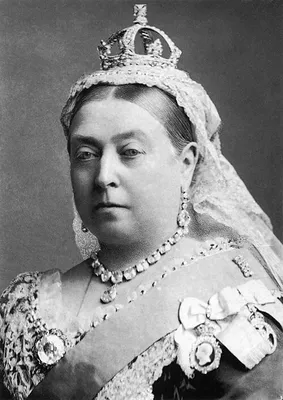
Queen Victoria's long reign defined an era of significant change and imperial expansion for the British Empire.
Victoria ascended to the British throne in 1837 at the age of 18, reigning for over 63 years until her death in 1901. Her tenure, known as the Victorian era, was a period of immense industrial, political, and scientific transformation, alongside a considerable expansion of the British Empire. She was granted the title Empress of India in 1876.
Born into the royal family, Victoria's early life was marked by the close supervision of her mother and comptroller, John Conroy, under what was known as the "Kensington System," designed to keep her dependent. Despite this, she developed an early interest in potential suitors, including her cousin Prince Albert, whom she married in 1840. Their nine children married into European royal and noble families, earning her the nickname "grandmother of Europe."
Following Prince Albert's death in 1861, Victoria entered a period of deep mourning and withdrawal from public life, which temporarily bolstered republican sentiment. However, her popularity rebounded in the latter half of her reign, celebrated by her Golden and Diamond jubilees. She was the last monarch of the House of Hanover, succeeded by her son Edward VII.
Early Life and Education
Born Alexandrina Victoria on May 24, 1819, she was the only child of Prince Edward, Duke of Kent, and Princess Victoria of Saxe-Coburg-Saalfeld. Her early years were shaped by the restrictive "Kensington System," implemented by her mother and comptroller, John Conroy, to ensure her dependence and isolation from outside influences. This strict upbringing involved constant supervision, limited social interaction, and a structured educational timetable. Victoria's education included languages such as French, German, Italian, and Latin, though she primarily spoke English at home. Despite the limitations, she showed early signs of independent thought, writing and illustrating a children's story at age ten. Her mother and Conroy also orchestrated public tours across England, which, while intended to present her as heir, often left the young princess exhausted and ill.
Path to the Throne and Marriage
Victoria's position in the line of succession shifted significantly due to the deaths of her father and grandfather, and the lack of surviving heirs from her father's elder brothers. By 1830, she became heir presumptive to King William IV. Her maternal uncle, Leopold, King of the Belgians, played a key role in her eventual marriage, promoting a union with his nephew, Prince Albert of Saxe-Coburg and Gotha. Victoria met Albert in 1836 and was favorably impressed by him, noting his handsome appearance and amiable nature in her diary. Although she was not yet ready to marry at seventeen, the prospect of this union was established. Upon turning eighteen in May 1837, she avoided the need for a regency, and less than a month later, following William IV's death, she ascended to the throne.
The Victorian Era and Imperial Influence
Queen Victoria's reign, spanning from 1837 to 1901, became synonymous with the Victorian era, a period characterized by profound societal and technological advancements, including the Industrial Revolution. Her rule saw a dramatic expansion of the British Empire, with territorial gains and increased global influence. The British Parliament bestowed upon her the title Empress of India in 1876, acknowledging the empire's vast reach. Victoria actively, though often privately, sought to influence government policies and ministerial appointments. Publicly, she cultivated an image of a national icon, embodying strict moral standards that defined the era's social ethos. Her long reign and the significant developments during this time cemented her legacy as one of Britain's most influential monarchs.
Notable Quotes
“I was awoke at 6 o'clock by Mamma, who told me the Archbishop of Canterbury and Lord Conyngham were here and wished to see me. I got out of bed and went into my sitting-room (only in my dressing gown) and alone, and saw them. Lord Conyngham then acquainted me that my poor Uncle, the King, was no more, and had expired at 12 minutes past 2 this morning, and consequently that I am Queen.”
“He is extremely handsome; his hair is about the same colour as mine; his eyes are large and blue, and he has a beautiful nose and a very sweet mouth with fine teeth; but the charm of his countenance is his expression, which is most delightful.”
“very plain”
“best and kindest adviser”
“for the prospect of great happiness you have contributed to give me, in the person of dear Albert ... He possesses every quality that could be desired to render me perfectly happy. He is so sensible, so kind, and so good, and so amiable too. He has besides the most pleasing and delightful exterior and appearance you can possibly see.”
Books by Melita Denning
8 free public domain books · Read online or download