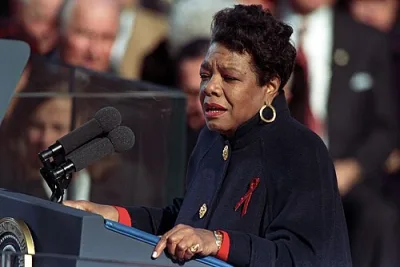
Maya Angelou
Maya Angelou's autobiographies explore themes of identity, family, racism, and travel, using a bird metaphor to represent struggle and resilience.
Maya Angelou, a renowned African-American writer, penned seven autobiographies between 1969 and 2013, exploring profound themes such as racism, identity, family, and the significance of travel. Her seminal work, "I Know Why the Caged Bird Sings," established a literary tradition of political protest within African-American literature, employing the metaphor of a caged bird struggling for freedom, inspired by Paul Laurence Dunbar's poem "Sympathy." This recurring motif symbolizes the confinement imposed by racism and depression, and the inherent human drive to overcome it.
Angelou's narratives chronicle her personal evolution, detailing shifts in her perspectives on Black-white relationships and her growing acceptance of diverse viewpoints. Her exploration of identity, particularly for Black women in a male-dominated society, was groundbreaking. Family relationships and the impact of abandonment are central, as are journeys that represent psychic mobility and the expansion of temporal and spatial boundaries, stretching from World War II to the Civil Rights era. Her writing process was highly disciplined, involving a specific morning ritual in secluded hotel rooms, aimed at transforming life experiences into profound art.
Literary Themes and Metaphors
Angelou's autobiographical series, beginning with "I Know Why the Caged Bird Sings," consistently weaves together core themes of racism, identity, family, and travel. A central metaphor throughout her work is the caged bird, drawn from Paul Laurence Dunbar's poem "Sympathy." This imagery represents the confinement experienced due to racism and depression, yet also signifies the bird's persistent song as a symbol of resilience and the struggle for liberation. Her writings are situated within the tradition of African-American political protest literature, directly addressing the injustices of racism and advocating for methods to combat it. Scholar Pierre A. Walker notes that her books offer a series of lessons on resisting oppression, charting a progression from initial rage to subtle and then overt forms of protest. Angelou's own views on race relations evolved significantly through her writing, fostering an acceptance of varied perspectives.
Identity and Family Narratives
The theme of identity is established from the outset of Angelou's autobiographical work, particularly in "I Know Why the Caged Bird Sings." Like many female writers of her era, she utilized autobiography to redefine narratives surrounding women's lives and identities within a patriarchal structure. Initially focused on the collective experiences of Black women in America, her later works shifted to document the personal and professional journey of her own life. Family relationships, including the profound impact of her parents' abandonment and her connections with her son, partners, and friends, are integral to all her books. These narratives draw from the rich tradition of African-American autobiography, which itself has roots in the slave narrative, where themes of family and resilience are paramount.
The Role of Travel and Historical Context
Travel serves as another significant thematic element in Angelou's autobiographies, echoing a tradition found in both American and African-American autobiographical writing. Scholar Yolanda M. Manora describes this travel motif as a "central metaphor for a psychic mobility." Angelou's narratives expand across vast distances and time, moving from Arkansas to Africa and back to the United States, covering a period of approximately forty years that spans from the beginning of World War II to the assassination of Martin Luther King Jr. This temporal and geographical scope allows her to contextualize personal experiences within broader historical and social movements, particularly the Civil Rights Movement.
Writing Process and Public Persona
Before embarking on her literary career, Maya Angelou had a diverse professional background, including roles as a composer, singer, actress, journalist, and educator. Her involvement in the Civil Rights Movement, inspired by Dr. Martin Luther King Jr., led her to organize benefits and coordinate for the Southern Christian Leadership Conference. After a period in Ghana, she was invited back to the U.S. by Malcolm X. Her decision to write "I Know Why the Caged Bird Sings" was prompted by encouragement from friends and her editor, Robert Loomis, despite her initial self-perception as a poet and playwright. Angelou developed a rigorous writing ritual, waking early to write in hotel rooms, using specific tools like sherry, playing cards, and reference books, to immerse herself in the past and articulate 'human truth' from traumatic experiences.
Key Ideas
- The caged bird as a metaphor for confinement by racism and depression, and the struggle for freedom.
- Autobiography as a form of political protest and a means to explore African-American identity.
- The evolution of personal views on race and the acceptance of diverse perspectives.
- Family relationships and abandonment as foundational elements of identity.
- Travel as a metaphor for psychic mobility and the expansion of consciousness.
- The disciplined writing ritual as a method for transforming life into art and confronting difficult truths.
Notable Quotes
“a sequence of lessons about resisting racist oppression”
“a central metaphor for a psychic mobility”
“It's just as well”
“because to write an autobiography as literature is just about impossible”
“judged the subsequent autobiographies in light of the first”
Books by Maya Angelou
4 free public domain books · Read online or download