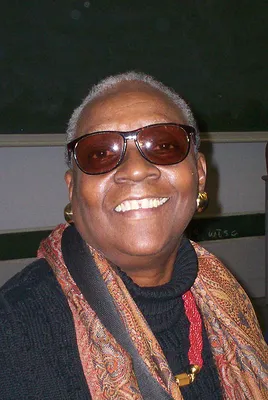
Maryse Condé
Maryse Condé was a Guadeloupean novelist and academic whose work explored the African diaspora and identity.
Maryse Condé, born in Guadeloupe in 1934 and passing in 2024, was a prolific French novelist, critic, and playwright. Her extensive academic career spanned West Africa, North America, the Caribbean, and Europe. Condé is celebrated for her literary exploration of the African diaspora, impacted by slavery and colonialism, particularly within the Caribbean context. Her novels, written in French, have been translated into numerous languages, and she received significant accolades throughout her career, including the Grand Prix Littéraire de la Femme and the New Academy Prize in Literature. Condé was frequently recognized as a potential Nobel Prize in Literature recipient.
Condé's writing often delved into complex themes of race, gender, and culture across various historical settings, from the Salem witch trials to the Bambara Empire. She frequently examined the connections between African peoples and their diaspora, with a particular focus on the Caribbean. While she maintained a distance from established Caribbean literary movements like Négritude, her work was deeply informed by feminist and political concerns, with Condé herself stating that her writing needed to possess political significance. Her novel *Windward Heights* offered a Caribbean reimagining of Emily Brontë's *Wuthering Heights*, exploring themes of race and culture.
Early Life and Influences
Born in Pointe-à-Pitre, Guadeloupe, Maryse Condé was the youngest of eight children. Her parents were among the first Black instructors in the region, with her mother directing a girls' school and her father founding a local bank. Condé began writing at a very young age, crafting a short play before she turned twelve. After completing high school, she pursued higher education in Paris, attending Lycée Fénelon and later the Université de Paris III (Sorbonne Nouvelle). During her studies, she was involved in establishing the Luis-Carlos Prestes club alongside other West Indian students.
Academic and Literary Career
Condé's career included extensive teaching roles across West Africa (Guinea, Ghana, Senegal) and Europe, as well as North America. Her early experiences in newly independent West African nations were formative, exposing her to influential figures and shaping her political consciousness, which she later chronicled. She faced deportation from Ghana due to accusations of subversive activity. After working for the BBC in London, she returned to academia in Paris, earning her Ph.D. in comparative literature. Condé published her first novel, *Hérémakhonon*, in her late thirties, but gained significant recognition with her third novel, *Ségou*. Her academic appointments included professorships at Columbia University and other prestigious institutions.
Thematic Exploration in Writing
Condé's literary output consistently addressed the legacies of slavery and colonialism, focusing on the African diaspora and the complexities of identity within the Caribbean. Her novels often examined the intersections of race, gender, and culture, drawing from diverse historical and geographical settings. She was known for her frank and cosmopolitan approach, often rejecting rigid categorization of her style. Condé's work frequently carried a strong political and feminist charge, reflecting her belief that writing should hold significant political meaning. Her novel *Windward Heights* is a notable example of her reinterpreting classic literature through a Caribbean lens, exploring themes of division based on race and culture.
Key Ideas
- Exploration of the African diaspora and its post-slavery/colonial realities
- Examination of racial, gender, and cultural complexities
- The search for identity and origins within the Caribbean context
- The intersection of personal experience and political significance in writing
- Reimagining of classic narratives through a Caribbean perspective
Notable Quotes
“I write in Maryse Condé.”
“I could not write anything... unless it has a certain political significance. I have nothing else to offer that remains important.”
“To be part of so many worlds – part of the African world because of the African slaves, part of the European world because of the European education – is a kind of double entendre. You can use that in your own way and give sentences another meaning. I was so pleased when I was doing that work, because it was a game, a kind of perverse but joyful game.”
Books by Maryse Condé
3 free public domain books · Read online or download