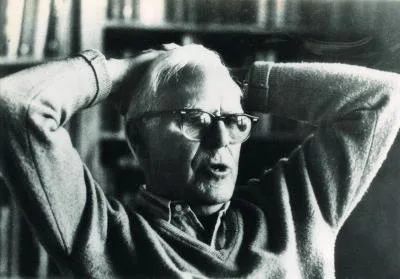
Martin Gardner was a prolific author known for popularizing recreational mathematics, scientific skepticism, and exploring connections between literature and logic.
Martin Gardner (1914-2010) was an American writer celebrated for his accessible explanations of mathematics and science, as well as his work in magic, skepticism, and philosophy. His career spanned over a century, during which he authored more than 100 books and countless articles. Gardner is particularly remembered for his "Mathematical Games" column in Scientific American, which ran for twenty-five years and introduced complex mathematical concepts to a broad audience, fostering a generation's interest in the field. His most successful work was "The Annotated Alice," a scholarly yet popular edition of Lewis Carroll's Alice books.
Beyond mathematics, Gardner was a staunch advocate for scientific skepticism and a critic of pseudoscience. He co-founded the Committee for the Scientific Investigation of Claims of the Paranormal (CSICOP) and authored influential critiques like "Fads and Fallacies in the Name of Science." His intellectual curiosity also led him to explore the works of authors like Lewis Carroll, L. Frank Baum, and G. K. Chesterton, often finding philosophical and logical connections. Gardner's ability to bridge diverse fields, from recreational math to literary analysis and skeptical inquiry, made him a unique and influential figure in 20th-century intellectual culture.
Popularizing Mathematics and Puzzles
Martin Gardner significantly impacted public understanding of mathematics, especially through his long-running "Mathematical Games" column in Scientific American. Beginning in 1957, this column ran for over twenty-five years and became a cornerstone of the magazine, introducing readers to recreational mathematics, puzzles, and intriguing mathematical concepts. Gardner's approach was characterized by clarity and engagement, making complex ideas accessible to a general audience. His ability to connect mathematics with other disciplines, such as magic, literature, and philosophy, broadened its appeal. He was considered a leading authority on puzzles and was instrumental in popularizing topics like flexagons, Conway's Game of Life, and Penrose tiles, inspiring many to pursue careers in mathematics and science.
Champion of Skepticism and Rational Inquiry
Gardner was a prominent voice in the scientific skepticism movement, dedicated to debunking pseudoscience and promoting rational thought. His 1957 book, "Fads and Fallacies in the Name of Science," remains a foundational text for skeptics, critically examining a wide range of pseudoscientific claims. He was a founding member of the Committee for the Scientific Investigation of Claims of the Paranormal (CSICOP) in 1976, an organization committed to rigorous scientific inquiry and the application of reason to extraordinary claims. Gardner consistently used his platform to challenge unsubstantiated beliefs and advocate for evidence-based reasoning, making him a significant polemicist against irrationality in the 20th century.
Literary Interests and Philosophical Explorations
A lifelong fascination with literature, particularly the works of Lewis Carroll, L. Frank Baum, and G. K. Chesterton, deeply informed Gardner's writing. His "The Annotated Alice" is a testament to this interest, offering extensive commentary on Carroll's "Alice's Adventures in Wonderland" and "Through the Looking-Glass," exploring their mathematical, logical, and philosophical underpinnings. Gardner often drew parallels between the imaginative worlds of these authors and logical or mathematical principles. His education in philosophy from the University of Chicago also provided a framework for his explorations of religion, magic, and the nature of belief, often approaching these subjects with a blend of intellectual rigor and playful curiosity.
Key Ideas
- Popularization of recreational mathematics
- Advocacy for scientific skepticism
- Exploration of logic and paradoxes in literature
- Critique of pseudoscience
Books by
2 free public domain books · Read online or download