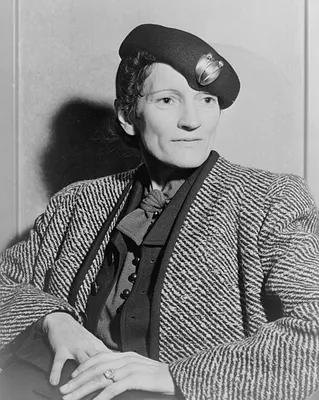
Mari Hall
Mari Sandoz was a Nebraska author known for her realistic portrayals of pioneer life and Plains Indians.
Mari Sandoz, born in 1896 near Hay Springs, Nebraska, became a prominent writer focusing on the American West, particularly pioneer experiences and the lives of Plains Indians. Her early life was marked by hardship on a family farm and limited formal education, yet she pursued writing despite significant challenges. After an unhappy marriage and divorce, she worked various jobs while striving to get her stories published. Her breakthrough came with the publication of 'Old Jules,' a biography of her father, which, after numerous rejections, was finally accepted and celebrated for its authentic depiction of frontier life. Sandoz's work often challenged romanticized notions of the West, incorporating strong language and realistic portrayals of its difficulties. She continued to write prolifically, exploring themes of resilience, cultural perspectives, and historical events.
Sandoz's career included novels like 'Slogum House' and 'Capital City,' which sometimes drew controversy for their unvarnished critiques of society. She also produced significant non-fiction, most notably the biography 'Crazy Horse: The Strange Man of the Oglalas,' lauded for its empathetic portrayal from a Lakota worldview. Her dedication to meticulous research and respect for Native American cultures is evident in works such as 'Cheyenne Autumn.' Beyond her writing, Sandoz was an educator and mentor, encouraging aspiring authors. She passed away in 1966, leaving behind a legacy recognized through various awards and posthumous inductions into halls of fame.
Early Life and Literary Beginnings
Born Marie Susette Sandoz in 1896 on the Nebraska frontier, she was the eldest of six children to Swiss immigrant parents. Her childhood was characterized by demanding farm labor and a strict father who discouraged her reading and writing. She spoke German until the age of nine and experienced hardship, including snow blindness from a blizzard. Despite lacking a high school diploma, she passed a rural teaching exam and taught for several years. After a brief, unhappy marriage, she moved to Lincoln and worked low-paying jobs while persistently writing fiction under her married name, Marie Macumber. She faced over a thousand rejections for her short stories. A pivotal moment arrived when her dying father requested she write his life story. This led to extensive research and the eventual publication of 'Old Jules,' under the name Mari Sandoz, which she had reverted to in 1929. The book's publication was a long struggle, with numerous rejections and a fight to retain its authentic Western language.
Literary Career and Thematic Focus
Mari Sandoz's literary output is marked by a deep engagement with the history and culture of the American West, particularly the experiences of pioneers and Native American tribes. Her novel 'Slogum House' (1937) explored themes of ambition and fascism in the Sandhills, drawing criticism and even bans in some Nebraska towns. 'Capital City' (1939) further stirred controversy, leading her to seek refuge in Denver and later New York for research and proximity to publishers. Her biography 'Crazy Horse: The Strange Man of the Oglalas' (1942) is considered a landmark work, praised for its attempt to capture the Lakota perspective using their own concepts and speech patterns. This approach, prioritizing cultural immersion and meticulous research, defined later works like 'Cheyenne Autumn' (1953) and other books in her Great Plains series, which examined Western history through the lens of specific animal species.
Legacy and Influence
Throughout her career, Mari Sandoz was dedicated to portraying the West with unflinching realism, often challenging romanticized narratives. Her writing embraced the hardships, resilience, and diverse voices of frontier life. Beyond her own creative work, Sandoz was committed to fostering literary talent, conducting writing workshops and offering guidance to aspiring authors. She advised them to write about subjects they knew intimately. Sandoz continued writing until shortly before her death in 1966 from bone cancer. Her contributions have been recognized through numerous awards, including an honorary doctorate, the Newbery Honor Medal, and Spur Awards. She was posthumously inducted into the Nebraska Hall of Fame and the Hall of Great Westerners, solidifying her status as a significant chronicler of the American West.
Key Ideas
- Realistic portrayal of pioneer life and the American West
- Focus on the experiences and perspectives of Plains Indians
- Challenging romanticized notions of frontier history
- Emphasis on meticulous research and authentic language
- Exploration of themes of hardship, resilience, and cultural identity
Notable Quotes
“I have used the simplest words possible, hoping by idiom and figures and the under-lying rhythm pattern to say some of the things of the Indian for which there are no white-man words, suggest something of his innate nature, something of his relationship to the earth and the sky and all that is between.”
Books by Mari Hall
5 free public domain books · Read online or download