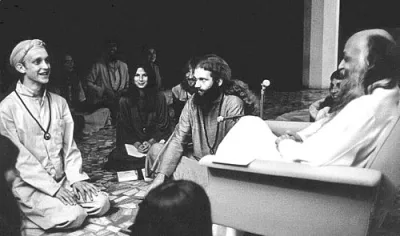
Maharishi Mahesh Yogi founded Maharishi International University, centered on consciousness-based education and Transcendental Meditation.
Maharishi Mahesh Yogi established Maharishi International University (MIU) in 1971, initially in California and later relocating to Fairfield, Iowa. The university's educational philosophy, termed "consciousness-based education," integrates the Transcendental Meditation (TM) technique with academic pursuits. Its core principles aim for individual potential development, economic fulfillment, environmental responsibility, and spiritual happiness. The institution has evolved significantly since its inception, with curriculum changes, campus development, and name alterations, eventually reverting to its original name in 2019.
Accredited through the doctoral level, MIU offers diverse degree programs, including fields like Vedic Science and regenerative organic agriculture, alongside traditional subjects. The university is known for its unique academic structure, such as the "block system" where students focus on one subject for four weeks. It has consistently attracted a multinational student body and has undergone substantial campus renovations, emphasizing green technology and Vedic architectural principles. Despite facing some external criticism and internal incidents, the university has continued to operate and expand its offerings.
Founding Principles and Educational Philosophy
Maharishi Mahesh Yogi founded Maharishi International University (MIU) with a vision for "consciousness-based education." This approach is fundamentally intertwined with the practice of Transcendental Meditation (TM). The university's founding tenets emphasize unlocking the full potential within each individual, harmonizing economic aspirations with environmental stewardship, and fostering spiritual fulfillment and happiness for humanity. The curriculum was initially developed from international symposia on the "Science of Creative Intelligence" (SCI), with the belief that integrating TM philosophy and techniques would offer a unique contribution to higher education. This foundational philosophy continues to shape the university's academic and personal development programs.
Academic Structure and Development
MIU's academic structure has been marked by innovation and adaptation. Initially, its interdisciplinary studies were modular, with courses lasting short durations. The university later implemented an academic "block system," dedicating four weeks to a single subject, allowing for deep immersion. Programs span a wide range, including traditional arts and sciences, business, and specialized fields like Vedic Science, regenerative organic agriculture, and sustainable living. The university has also been recognized for its efforts in sustainable campus development, incorporating green technology and principles of Vedic architecture in its construction and renovation projects. The student body is notably international, contributing to a diverse learning environment.
Campus Evolution and Community
The university's physical campus has undergone significant transformation since its founding. Initially located in California, it relocated to Fairfield, Iowa, in 1974, acquiring the former Parsons College campus. Over the years, many older structures were replaced with new buildings designed with eco-friendly principles and Maharishi Vastu Architecture. The campus features dedicated meditation facilities, including the "Golden Domes," for group practice of TM and TM-Sidhi programs. The university has fostered a strong sense of community, historically emphasizing a drug- and alcohol-free environment. Despite demolitions of some historic buildings, efforts have been made to preserve architectural elements and artifacts.
Key Ideas
- Consciousness-based education
- Transcendental Meditation integration
- Science of Creative Intelligence
- Unlocking individual potential
- Harmonizing economic and environmental goals
- Fostering spiritual fulfillment
- Vedic architecture principles in campus design
- Academic block system
Books by
9 free public domain books · Read online or download