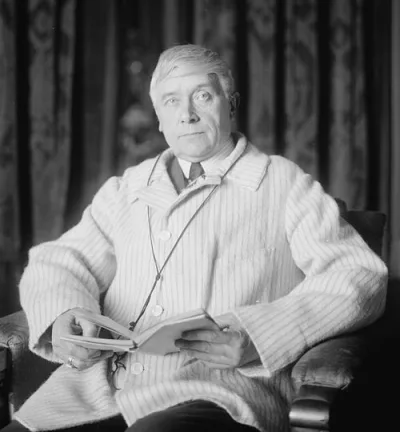
Maeterlinck, Maurice
Belgian Symbolist writer Maurice Maeterlinck, Nobel laureate, explored themes of death and life's meaning, later facing plagiarism accusations.
Maurice Maeterlinck, a Belgian playwright, poet, and essayist who wrote in French, was a significant figure in the Symbolist movement. Born in Ghent in 1862, he initially pursued law but was drawn to the Symbolist literary scene in Paris. His early plays, like "Princess Maleine," brought him critical acclaim and established his reputation. Maeterlinck's work often delved into profound themes such as death and the search for life's meaning, frequently employing mystical and fatalistic elements, sometimes presented in fairy tale-like narratives that appealed to the imagination.
Awarded the Nobel Prize in Literature in 1911 for his imaginative and poetic dramatic works, Maeterlinck's career was marked by significant relationships, notably with singer Georgette Leblanc, who influenced his writing and performed his characters. While his early work was deeply rooted in Symbolism, his style evolved towards a more existential approach. Later in his life, Maeterlinck faced serious accusations of plagiarism concerning his book on termites, "The Life of Termites," which closely mirrored the work of Afrikaner scientist Eugène Marais. He passed away in 1949.
Symbolist Dramatist and Mystic
Maurice Maeterlinck emerged as a prominent voice within the Symbolist movement, a literary and artistic current that sought to express subjective emotions and ideas through symbolic imagery. His early plays, such as "Princess Maleine," "Intruder," "The Blind," and "Pelléas and Mélisande," are characterized by a profound sense of fatalism and mysticism. Maeterlinck's dramatic works often explored the mysteries of existence, with death and the meaning of life serving as central preoccupations. These plays frequently adopted the guise of fairy tales, using poetic language and a sense of the unknown to evoke deep emotional responses and stimulate the audience's imagination. His approach was deeply influenced by his early experiences and his exposure to Parisian Symbolist circles, particularly the work of Villiers de l'Isle Adam.
Philosophical and Existential Explorations
Throughout his career, Maeterlinck's writing was infused with mystical and metaphysical underpinnings. While his early works leaned heavily into Symbolism, his style gradually shifted towards a more existential outlook. This evolution is evident in his later plays, where characters, particularly female figures, began to exhibit greater agency. His essays, such as "The Treasure of the Humble" and "The Life of the Bee," expanded on his philosophical inquiries, touching upon ethics, natural history, and the human condition. Maeterlinck also displayed sympathy for socialist ideals and was critical of organized religion, particularly the Catholic Church, which he felt misrepresented universal truths. His intellectual journey saw him grappling with profound questions about consciousness, the natural world, and humanity's place within it.
Later Life and Controversies
Maeterlinck's later years were marked by both continued literary output and significant personal and professional challenges. His relationship with actress Georgette Leblanc significantly influenced his work for two decades, and he later married Renée Dahon. Despite receiving the Nobel Prize in Literature in 1911, his reputation as a detached sage was somewhat diminished by his involvement in public discourse, particularly his strong anti-German sentiments during World War I. A major controversy arose in 1926 with the publication of "The Life of Termites." This book was widely recognized as plagiarizing the work of Afrikaner scientist Eugène Marais, who accused Maeterlinck of verbally copying extensive passages and appropriating his research on termite colonies. This incident cast a shadow over his legacy, leading to accusations of academic dishonesty and undermining his standing as an original thinker.
Key Ideas
- Exploration of death and the meaning of life
- Symbolism and mysticism in drama
- Fatalism and existential themes
- The power of imagination and poetic fancy
- Critique of organized religion
- Interest in occultism, ethics, and natural history
Notable Quotes
“in appreciation of his many-sided literary activities, and especially of his dramatic works, which are distinguished by a wealth of imagination and by a poetic fancy, which reveals, sometimes in the guise of a fairy tale, a deep inspiration, while in a mysterious way they appeal to the readers' own feelings and stimulate their imaginations”
Books by Maeterlinck, Maurice
0 free public domain books · Read online or download