Liu Da
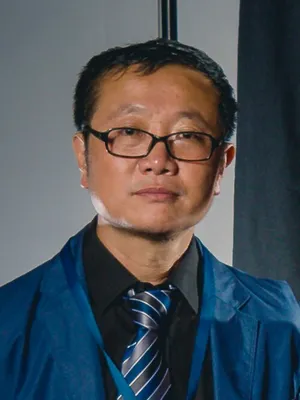
Liu Cixin is a Chinese computer engineer and acclaimed science fiction author known for hard sci-fi exploring humanity's place in the universe.
Liu Cixin, born in 1963, is a Chinese computer engineer and a highly regarded science fiction writer, sometimes referred to as "Da Liu." He has received numerous accolades, including China's Galaxy Award nine times, the 2015 Hugo Award for his novel "The Three-Body Problem," and the 2017 Locus Award for "Death's End." His work often delves into hard science fiction, incorporating advanced scientific theories and exploring profound philosophical questions about humanity, society, and the cosmos.
Liu's career began after graduating in 1988 and working as a computer engineer. While employed, he penned his early novels. He is also recognized for "Electronic Poet," a pioneering poetry generation program. His writing frequently examines themes of social inequality, the implications of scientific advancement, and ecological limits. Influenced by authors like Arthur C. Clarke and George Orwell, Liu aims to bridge the gap between complex scientific concepts and a wider audience through accessible storytelling, emphasizing the majesty and wonder of science.
Hard Science Fiction and Cosmic Perspective
Liu Cixin is a prominent figure in hard science fiction, a genre that emphasizes scientific accuracy and plausibility. His narratives frequently integrate complex astrophysical concepts, such as wormholes, the curvature of the universe, and black holes, drawing inspiration from scientific theories. A central theme in his work is the exploration of humanity's relatively small place within the vastness of the universe. He posits that human concerns and morality often pale in significance when contrasted with the grand scale of cosmic existence and scientific progress. This perspective is vividly illustrated through encounters with alien civilizations, whose advanced science and technology often dwarf human capabilities, thereby challenging anthropocentric viewpoints.
Themes of Posthumanism and Societal Critique
A recurring motif in Liu's writing is posthumanism, which reflects his belief that science and technology hold a greater significance than human life and morality in the grand cosmic scheme. His stories often depict humanity confronting existential challenges posed by superior extraterrestrial intelligence, forcing a re-evaluation of human importance. Beyond posthumanism, Liu employs his fiction as a vehicle for subtle political criticism, particularly through utopian or speculative settings. His early novel, "China 2185," is cited as an example where a democratic, utopian vision serves as an implicit critique of the contemporary political climate, encouraging readers to view societal structures with skepticism and consider alternative possibilities for governance and human society.
The 'Sci-Fi Realism' Approach
Liu Cixin is credited with coining the critical theory of 'sci-fi realism.' This approach emphasizes the evolution of science fiction as a genre in parallel with the actual growth of science and technology. According to Liu, grounding imaginative science fiction concepts in a recognizable reality is crucial. He believes that writers strive to make the unbelievable plausible by anchoring it in some form of established truth or scientific principle. This method allows him to explore the 'beauty' of science and technology, making them accessible to a broader audience by demystifying complex subjects and presenting them in a compelling narrative form, thus bridging the perceived gap between scientific expertise and general understanding.
Key Ideas
- Posthumanism: Human significance diminishes against the backdrop of cosmic scale and scientific advancement.
- Political critique through utopia: Speculative settings used to implicitly comment on real-world governance.
- Sci-fi realism: Grounding imaginative concepts in scientific plausibility to make science accessible.
- Humanity's place in the universe: Exploring the existential implications of humanity's cosmic isolation or encounters with advanced alien life.
Books by Liu Da
5 free public domain books · Read online or download