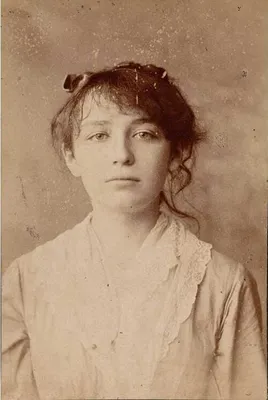
Linda Schierse Leonard
Camille Claudel was a French sculptor known for her figurative works, who gained posthumous recognition for her originality.
Camille Claudel was a French sculptor celebrated for her expressive bronze and marble figures. Despite her talent and significant artistic contributions, she died in relative obscurity. However, her work experienced a resurgence in the latter half of the 20th century, leading to widespread recognition for its unique quality and originality. Claudel's artistic journey began in her youth, influenced by the landscapes of her upbringing and supported by her father, who recognized her talent. She pursued formal artistic training in Paris, overcoming societal limitations placed on women artists at the time. Her career was marked by a significant association with sculptor Auguste Rodin, both professionally and personally, though their relationship was complex and ultimately strained.
Claudel's artistic output, including pieces like "The Waltz" and "The Mature Age," showcased a distinct style that critics noted for its imagination, lyricism, and at times, a "virile" quality. Her work often explored themes with a depth and perspective that diverged from her male contemporaries, sometimes challenging prevailing aesthetic norms and the "male gaze." While her association with Rodin was prominent, her legacy is firmly established by the merit of her own creations. Today, her sculptures are housed in major museums worldwide, and institutions like the Camille Claudel Museum are dedicated to her art.
Early Artistic Development
Born in northern France, Camille Claudel's early life was shaped by the rural landscape, which left a lasting impression. Her father, involved in finance, recognized and encouraged her nascent artistic talent, a stark contrast to her mother's disapproval of her "unladylike" ambitions. Claudel began sculpting with clay at age 12, developing her skills through self-study and exposure to art. Her father's support was crucial, leading him to seek the opinion of the established sculptor Alfred Boucher. Boucher affirmed Claudel's abilities, prompting her family to allow her to pursue formal artistic education. In 1881, the family relocated to Paris to provide Camille and her siblings with greater educational opportunities, while her father remained to support them financially.
Artistic Training and Association with Rodin
In Paris, Claudel studied at the Académie Colarossi, one of the few institutions that admitted female students and allowed them to work with nude male models, unlike the more restrictive École des Beaux-Arts. She also received instruction from Alfred Boucher, who later introduced her to Auguste Rodin. Claudel began working in Rodin's studio in 1883, becoming both a muse and collaborator. Under Rodin's tutelage, she honed her skills in various materials like plaster, bronze, and marble. Their professional and personal relationship was intense and passionate, though Rodin remained with his longtime partner, which caused familial discord for Claudel. Despite societal and familial pressures, Claudel pursued her artistic independence, though funding and recognition were often challenging, sometimes requiring her to depend on Rodin or see him receive credit for joint endeavors.
Distinct Artistic Vision and Legacy
Claudel's work, while initially influenced by Rodin, developed a unique voice characterized by imagination, lyricism, and a powerful expressiveness. Critics noted her style as distinctive, with some describing it as "virile" and possessing vigorous contrasts, setting it apart from Rodin's evolving aesthetic. Pieces like "The Waltz" and "The Mature Age" exemplify her original vision. Her sculpture "Clotho" was particularly noted for its unflinching depiction of an elderly woman, demonstrating a willingness to explore the "female grotesque" and an "utter indifference to the male gaze." This divergence from prevailing artistic conventions and her profound exploration of life's stages and complexities contributed to her eventual break with Rodin and her independent artistic trajectory. Though she faced challenges and died in relative obscurity, Claudel's artistic merit has since been widely acknowledged, with her sculptures now featured in prominent collections and dedicated museum spaces.
Key Ideas
- Exploration of the "female grotesque" and finding power in unconventional depictions.
- Challenging the "male gaze" through artistic expression.
- Depicting the stages of life and human destiny with unique symbolic interpretations.
- Developing a distinct artistic style characterized by imagination, lyricism, and vigorous contrasts.
Notable Quotes
“A revolt against nature: a woman genius.”
“The life that was, is, and will be in Maturity contains within its movement both the relentless movement of Clotho and the rhythmic, graceful, whirling movement of Fortune, generating a single and sustaining movement or image out of the differences within”
“consummated in an unending death”
“rapture or total harmony”
Books by Linda Schierse Leonard
3 free public domain books · Read online or download