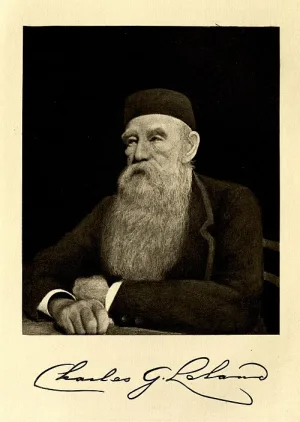
Leland, Charles Godfrey
Charles Godfrey Leland documented Aradia, a figure he presented as a witch messiah, influencing modern pagan witchcraft.
Charles Godfrey Leland, an American folklorist, published "Aradia, or the Gospel of the Witches" in 1899. In this work, he presented Aradia as a messianic figure sent to teach peasants sorcery for liberation from oppressive social structures, particularly the Roman Catholic Church and landowners. Leland claimed the text was a genuine religious document from Tuscan witches, though this assertion has been questioned by later scholars. He also linked Aradia to figures like Herodias and speculated on ancient Etruscan roots.
Aradia's portrayal as a divine figure and teacher of witchcraft has significantly impacted modern paganism. She is considered a central figure in the witchcraft revival, appearing in various Neopagan traditions like Wicca and Stregheria. Some, like Raven Grimassi, founder of Stregheria, propose Aradia was a historical figure who led a 14th-century Tuscan witch group. Leland's work, while debated in its authenticity, has inspired numerous contemporary pagan narratives and practices, framing witchcraft as a tool for empowerment and resistance.
Origins and Folklore Connections
The figure of Aradia, as presented by Charles Godfrey Leland, is deeply intertwined with older European folklore. Leland believed he was documenting a genuine witch tradition, positing Aradia as a messianic figure descended from Diana and Lucifer. His work connects Aradia to the biblical Herodias, a figure who in medieval Christian lore was seen as a wandering spirit associated with a celestial hunt. This connection is further elaborated by scholars who trace the name and mythos through various Italian and Sardinian folklore, linking it to figures like "s'Araja dimoniu" and "s'Araja justa." The folklorist Sabina Magliocco theorized that Aradia may have originated as a supernatural entity in Italian folklore before being incorporated into Leland's text, possibly merging with other folkloric characters.
Leland's "Aradia, or the Gospel of the Witches"
Leland's 1899 publication, "Aradia, or the Gospel of the Witches," is central to his legacy. He claimed the text was an authentic religious manuscript given to him by a Tuscan woman, detailing the teachings of Aradia, a figure sent to empower the oppressed through witchcraft. The narrative describes Aradia as the daughter of Diana and Lucifer, tasked with instructing humanity in magical arts to achieve freedom from societal and religious dominance. Leland himself speculated about the ancient Etruscan origins of these beliefs and identified Aradia with Herodias, suggesting a lineage that might even connect to Lilith. However, the veracity of Leland's claims regarding the text's origin and nature has been a subject of considerable scholarly debate.
Influence on Modern Neopaganism
Since its publication, "Aradia, or the Gospel of the Witches" has become a foundational text for many modern pagan witchcraft traditions. Aradia is widely recognized as a significant deity or spiritual figure within Neopaganism, particularly in Wicca and Stregheria. Her story has inspired numerous interpretations and rituals, with figures like Raven Grimassi developing the tradition of Stregheria based on his belief in Aradia's historical existence. Contemporary pagan authors and practitioners continue to engage with the Aradia mythos, reinterpreting her as a symbol of resistance, empowerment, and divine feminine energy. Campaigns like "#WeAreAradia" and publications such as "The New Aradia: A Witch’s Handbook to Magical Resistance" highlight her ongoing relevance as an icon for social and political activism within magical communities.
Key Ideas
- Aradia as a messianic figure sent to liberate the oppressed through witchcraft.
- The connection between Aradia, Diana, and Herodias in folklore and witchcraft traditions.
- Leland's text as a source for modern Neopagan witchcraft practices and beliefs.
- Aradia as a symbol of resistance against social and economic injustice.
Notable Quotes
“go to earth below / To be a teacher unto women and men / Who fain would study witchcraft.”
“ye shall all be freed from slavery, / And so ye shall be free in everything.”
“I also believe that in this Gospel of the Witches we have a trustworthy outline at least of the doctrine and rites observed at these meetings [the witches' Sabbat]. They adored forbidden deities and practised forbidden deeds, inspired as much by rebellion against Society as by their own passions.”
Books by Leland, Charles Godfrey
0 free public domain books · Read online or download