Lawrence Principe
Lawrence Principe, a chemist and historian, has explored alchemical texts like 'The Twelve Keys of Basil Valentine' through a physicochemical lens.
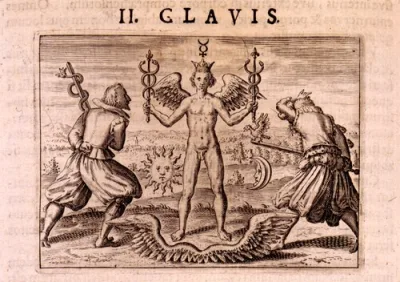
Lawrence M. Principe, a chemist and historian, has applied his expertise to interpret alchemical texts, specifically focusing on 'The Twelve Keys of Basil Valentine'. This book, first published in 1599, is presented as a sequence of allegorical alchemical operations, accompanied by symbolic imagery. The text is divided into general alchemical principles and advice on the philosopher's stone, followed by twelve chapters, or 'keys', detailing steps in the creation of the philosopher's stone. Each key uses changing symbolic names for ingredients as they transform, requiring a knowledgeable reader to decipher its veiled language and illustrations.
Principe's approach involves a physicochemical interpretation, drawing upon knowledge of alchemical symbolism and experimentally testing potential chemical processes that might correspond to the steps described in the text and its associated 1602 woodcuts. He suggests that some keys might describe actual laboratory techniques, while others could represent theoretical ideas or extrapolations of experiments. The later keys might even be based on the writings of other alchemists. This work builds on the historical interest in these texts, as figures like Robert Boyle and Isaac Newton also studied the writings attributed to Basil Valentine.
Physicochemical Interpretation of Alchemical Texts
Lawrence M. Principe, a chemist and historian, has proposed a physicochemical interpretation of alchemical writings, which are often obscured by allegorical language and fantastical imagery. He has specifically examined 'The Twelve Keys of Basil Valentine,' a significant alchemical text. Principe's methodology involves leveraging his understanding of chrysopoetic symbolism, the symbolic language of alchemy, and conducting experimental tests on potential chemical processes. He correlates these findings with the descriptions found in the text and the visual elements, particularly the woodcuts from the 1602 edition. Principe theorizes that the twelve keys may not represent a single type of information but rather a combination of different forms.
Analyzing 'The Twelve Keys'
Principe speculates that the early 'keys' within Basil Valentine's work might encode descriptions of actual laboratory techniques and the observed results of alchemical experiments. In contrast, he suggests that some of the later keys could represent theoretical advancements or conceptual extrapolations, outlining ideas for experiments that may not have been successfully carried out at the time. Furthermore, Principe posits that the final keys might draw upon textual precedents from other alchemical writers, indicating a synthesis of existing knowledge. This layered interpretation aims to reconcile the allegorical nature of the text with potential practical alchemical procedures, acknowledging that the texts themselves predate the accompanying illustrations.
Key Ideas
- Physicochemical interpretation of alchemical texts
- Experimental testing of alchemical processes
- Allegorical and symbolic language in alchemy
- Potential for alchemical texts to describe both practical techniques and theoretical concepts
Books by Lawrence Principe
10 free public domain books · Read online or download