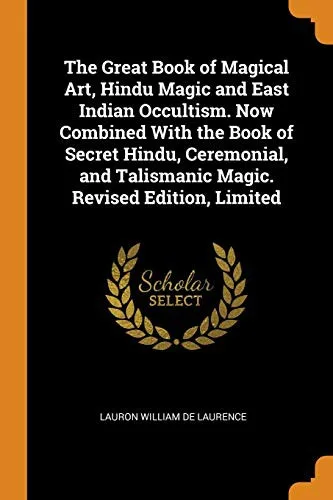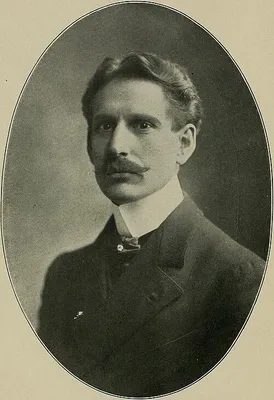
Lauron William De Laurence
Lauron William De Laurence was a controversial occult publisher and self-styled spiritual authority known for his influential editions of esoteric texts.
Lauron William De Laurence (1868-1936) was an American figure who gained notoriety in the early 20th century as an occult author, publisher, and self-proclaimed spiritual leader. Initially working as a traveling hypnotist and healer, he established the De Laurence Institute of Hypnotism and Occult Philosophy in Chicago in 1902. He promoted himself with grandiose claims of Eastern initiation and unique knowledge, often repackaging material from other authors with an exotic flair. His institute, however, faced legal trouble, leading to his arrest in 1904 for fraud. Despite these controversies and a later arrest in 1912 related to the "Order of the Black Rose," De Laurence became a prolific mail-order publisher. His company, De Laurence, Scott & Co., distributed a wide array of occult literature and spiritual goods, significantly influencing magical practices within the African diaspora.
Early Career and Institute
Born in 1868, Lauron William De Laurence began his career as a magnetic healer and hypnotist, traveling across Canada and the American Midwest. After relocating to Chicago in 1900, he published his first book on hypnotism and related practices, marking his entry into occult publishing. In 1902, he founded the De Laurence Institute of Hypnotism and Occult Philosophy, presenting it as a premier institution for learning hypnotism, magnetism, and psychic development. He advertised courses promising success and the ability to overcome negative influences, claiming rapid and effortless hypnotic induction methods. His marketing employed theatrical self-promotion, styling himself as an "adept" trained by "Eastern Adepts" and "Yogis," though no evidence supports these claims. He asserted his institute taught the "oldest and only true knowledge" of occultism and hypnotism, positioning himself as the sole authority.
Controversies and Publishing Ventures
De Laurence's methods involved significant self-aggrandizement and the dismissal of rivals as frauds. His early book, "Hypnotism, and Magnetism, Mesmerism, Suggestive Therapeutics and Magnetic Healing," contained material closely resembling that of Dr. Herbert A. Parkyn's work, often without attribution. The De Laurence Institute functioned largely as a promotional front for his publishing company, De Laurence, Scott & Co., founded in 1902. In 1903, he advertised for "hypnotic models," seeking young, impressionable women for demonstrations, claiming it proved hypnosis could instill obedience and cure habits. The institute closed in 1904 following his arrest for obtaining money under false pretenses, accused by a student who claimed to have paid for instruction but received none. He later re-emerged as a professional palmist before focusing on his publishing business.
Influence and Legacy
Despite legal troubles and accusations of fraud, De Laurence became a significant figure in occult publishing through his mail-order firm, De Laurence, Scott & Co. The company became a major supplier of esoteric literature and spiritual items, including books, incense, and ritual tools, distributed nationwide and internationally. His reprints of public domain works, such as "Secrets of the Psalms" and "Pow-Wows; or, the Long-Lost Friend," proved particularly influential. These editions had a lasting impact on Hoodoo practices in the southern United States and spiritual traditions in the Caribbean and parts of Africa. De Laurence's career, marked by controversial self-promotion and the repackaging of esoteric knowledge, ultimately established him as a key promoter of magical teachings during the early 20th century.
Key Ideas
- Self-styled spiritual authority and expert in hypnotism and occult philosophy.
- Promotion of esoteric teachings through mail-order publishing.
- Claims of exclusive knowledge derived from Eastern traditions.
- Influence on magical practices in the African diaspora.
Notable Quotes
“Those who are interested in these sciences are most emphatically informed and warned that in these times of humbugs, imitators, and impostors, there is only one standard of truth.”
“An ounce of truth and science for every ounce of theory, imposture, and simulation.”
Books by Lauron William De Laurence
5 free public domain books · Read online or download