Klaus E. Müller
Klaus Mann was a German writer and anti-fascist activist, known for his novel 'Mephisto' and his writings on exile.
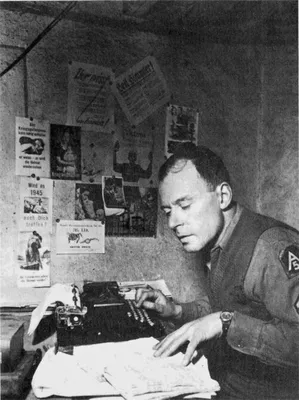
Klaus Mann, son of Thomas Mann, was a German writer and prominent anti-fascist activist. Fleeing Nazism, he lived in exile, primarily in the United States, and served in counterintelligence during World War II, witnessing the horrors of concentration camps. Mann's literary works, including 'Escape to Life' and 'The Turning Point,' are significant primary documents reflecting the experiences of German intellectuals and artists who escaped the Third Reich, a genre known as Exilliteratur.
His most famous novel, 'Mephisto' (1936), is a semi-fictional account of an actor who compromises his values by aligning with the Nazi regime for career advancement. The protagonist was modeled on his former lover, Gustaf Gründgens. 'Mephisto' was banned in West Germany for decades due to personality rights claims but later became a celebrated film adaptation. Mann also co-founded literary magazines like 'Die Sammlung' and 'Decision' to support exiled German writers and actively engaged in anti-fascist political commentary.
Early Life and Literary Beginnings
Born in Munich, Klaus Mann was the son of renowned writer Thomas Mann and Katia Pringsheim. He came from a family with a rich intellectual background, including his uncle Heinrich Mann. Mann's early life was spent in affluent surroundings, but his homosexuality presented personal challenges and shaped his complex relationship with his father. He began writing short stories in 1924 and soon after became a drama critic. His first literary works, published in 1925, included the novel 'The Pious Dance, Adventure Book of a Youth' (1926), which openly depicted Berlin's homosexual milieu. Mann was briefly engaged to Pamela Wedekind, daughter of playwright Frank Wedekind, but the engagement was broken off.
Exile and Anti-Fascist Activism
To escape the rise of Nazism, Klaus Mann relocated to the United States. Before settling there, he traveled extensively with his sister Erika, documenting their journeys in the collaborative travelogue 'Rundherum' (1929). Mann battled drug addiction throughout his adult life, undergoing detoxification multiple times. In 1933, he co-founded the literary magazine 'Die Sammlung' with Annemarie Schwarzenbach and others, providing a platform for exiled German writers. He also co-authored 'Escape to Life' with Erika, a work aimed at uniting German intellectuals against Nazi ideology. His German citizenship was revoked in 1934, and he became a Czechoslovak citizen.
'Mephisto' and its Legacy
Klaus Mann's most impactful novel, 'Mephisto,' published in 1936, chronicles an actor's ascent to fame by aligning with the Nazi regime, effectively selling his soul for professional success. The character of Hendrik Höfgen is widely understood to be based on actor Gustaf Gründgens. The novel's unflinching portrayal of moral compromise within the context of Nazism led to its ban in West Germany for many years after its initial publication, due to legal challenges concerning personality rights. The book was later adapted into a critically acclaimed film in 1981. 'The Turning Point' is another significant work often cited as a primary document of the exile experience.
Later Life and Continued Exile
In 1936, Mann moved to the United States, residing in Princeton and New York. During World War II, he trained as part of the Ritchie Boys, a unit specializing in counterintelligence, and served in Europe, encountering the devastating reality of concentration camps firsthand. In 1940, he established the literary magazine 'Decision' in the U.S. to support exiled German writers and foster intellectual opposition to the war. His novel 'Der Vulkan' (1939) explored the experiences of German and other European exiles during the war's onset. Mann continued his anti-fascist activism throughout his life.
Key Ideas
- Exile literature (Exilliteratur) as a reflection of the German intelligentsia's experience fleeing Nazism.
- Moral compromise and the corrupting influence of political power on artistic integrity.
- The psychological and social impact of totalitarian regimes on individuals and society.
Books by Klaus E. Müller
0 free public domain books · Read online or download